
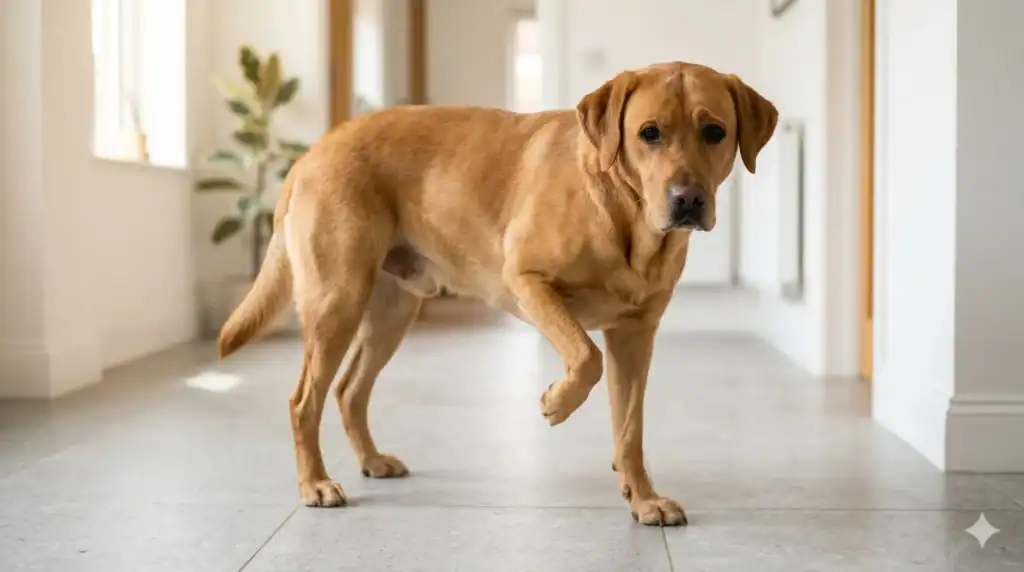
When a dog is limping but not crying, most owners assume it is minor — a sore paw, a tired muscle, a bad step. Vets know better. Dogs are biologically wired to conceal pain and weakness, a survival instinct inherited from their wild ancestors. By the time a dog limps visibly, the underlying cause has often been developing for weeks. The absence of crying is not a sign that the pain is mild — it is a sign that your dog is coping silently.
A dog limping without crying is not necessarily fine — dogs instinctively hide pain. If the limp is consistent, worsens after rest, affects a specific leg, or appears alongside any behavioural change, see a vet. Never give human pain medication (ibuprofen, acetaminophen) to a limping dog — both are toxic.
THE 15 CAUSES AT A GLANCE
Sudden Onset — Seek Vet Care Promptly:
1. CCL (Cranial Cruciate Ligament) tear
2. Paw pad injury (cut, thorn, burn, foreign object)
3. Broken or severely overgrown nail
4. Insect sting or bite on the paw
5. Bone fracture (including stress fracture)
Gradual Onset — Book a Vet Appointment:
6. Hip dysplasia
7. Elbow dysplasia
8. Luxating patella (slipping kneecap)
9. Osteoarthritis
10. Intervertebral disc disease (IVDD)
11. Osteosarcoma (bone cancer)
Systemic or Less Obvious Causes:
12. Lyme disease or tick-borne illness
13. Panosteitis (growing pains in puppies)
14. Nerve damage or neurological issue
15. Soft tissue injury (sprain or strain)
Why Dogs Don’t Cry When They Are in Pain
Dogs evolved in environments where showing weakness meant becoming prey or losing their place in the pack. This instinct is still hardwired today. A dog in significant pain will often continue to wag its tail, eat normally, and even play — all while hiding a condition that has been progressively worsening. This is why vets are trained to look beyond vocalisation and focus on subtle behavioural and physical signals instead.
The 15 Silent Pain Signals Vets Check For
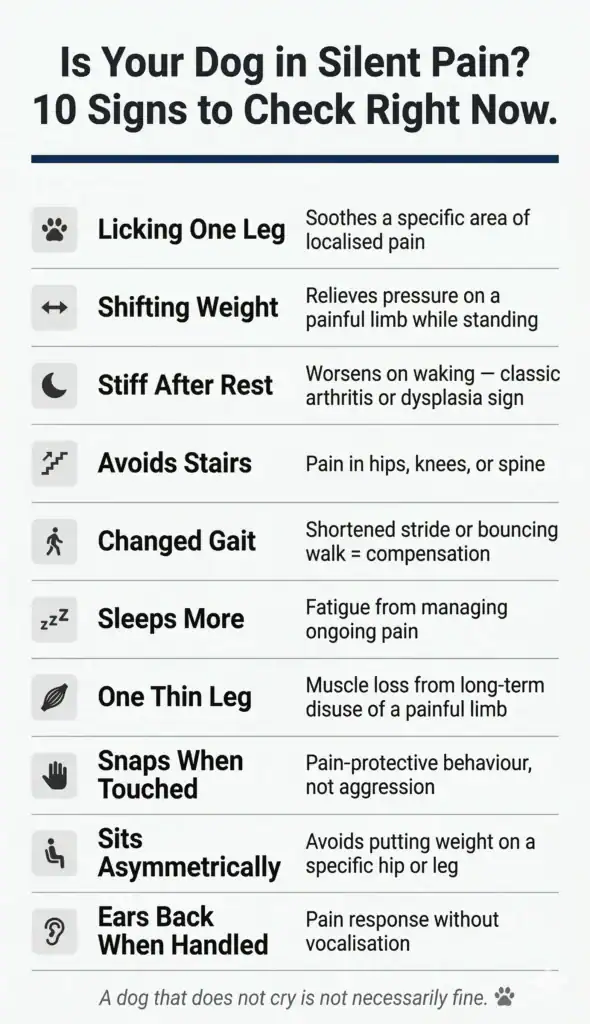
| Signal | What It Looks Like | Why It Matters |
|---|---|---|
| Shifting weight | Dog constantly moves weight off one leg while standing | Relieves pressure on a painful joint or limb |
| Stiffness after rest | Limping is worst when getting up, improves after moving | Classic sign of arthritis or hip dysplasia |
| Licking one leg or paw | Repetitive licking of a specific spot with no visible wound | Localised pain response; the dog soothes the area |
| Reluctance to climb stairs | Hesitates or refuses steps it previously took easily | Pain in the hips, knees, or spine |
| Changes in gait | Bouncing walk, shortened stride, or swinging a leg out | Compensating for pain or limited range of motion |
| Sitting or lying asymmetrically | Favours one side when resting, avoids putting a leg down | Discomfort in a hip, knee, or shoulder |
| Flattened ears when touched | Ears go back when a specific area is palpated | Pain response without vocalisation |
| Reduced activity | Sleeps more, less interested in walks, slower to get up | Fatigue from managing chronic pain |
| Muscle atrophy | One leg visibly thinner than the opposite leg | Muscle loss from long-term reduced use of a painful limb |
| Aggression when touched | Growls or snaps when a leg or joint is handled | Pain-protective behaviour, not a personality change |
The 15 Causes Explained
SUDDEN ONSET CAUSES
1. CCL (Cranial Cruciate Ligament) Tear
The most common orthopaedic injury in dogs. The CCL is the canine equivalent of the human ACL, and it stabilises the knee joint. It can tear suddenly during play or deteriorate gradually over time. Dogs often walk on a torn CCL without vocalising — the limp appears suddenly and does not improve with rest.
Breeds most at risk: Labrador Retrievers, Golden Retrievers, Rottweilers, Bulldogs, and any overweight dog. For Golden Retrievers specifically, CCL tears are one of the most common health concerns — see our full guide on Golden Retriever Complete Care: Health, Training & Grooming.
Signs to watch: sudden hind leg lameness, holding the leg up when standing still, a subtle “drawer” movement in the knee when manipulated.
Action: Vet appointment within 24 hours. Diagnosis requires physical examination and X-ray. Treatment ranges from strict rest and physiotherapy to surgery (TPLO or TTA) depending on severity and dog size.
2. Paw Pad Injury
Cuts from glass or gravel, thorns, burns from hot pavement, or a foreign object lodged between the toes are all common and frequently missed. Dogs often lick the affected paw but do not cry.
Signs to watch: licking one specific paw, slight limp that worsens on rough surfaces, visible redness or swelling between the toes, reluctance to put weight on the foot.
Action: Examine the paw carefully in good light. Clean minor cuts with saline, apply a clean bandage, and monitor. If you find a lodged object, swelling, or an infected-looking wound, see a vet.
3. Broken or Severely Overgrown Nail
A nail that cracks, splits, or breaks at the base is extremely painful but dogs rarely vocalise it. An overgrown nail that curves back into the paw pad is equally painful and easy to miss under long coat fur.
Signs to watch: sudden limp on one leg, bleeding from one toe, excessive licking of one paw, visible nail damage or missing nail.
Action: A broken nail at the base needs veterinary attention — it often requires sedation to remove the damaged nail safely. Prevent with regular nail trims every 4–6 weeks.
4. Insect Sting or Bite on the Paw
A bee sting or ant bite on the paw causes immediate swelling and pain. The dog limps suddenly with no prior history and the paw may appear visibly swollen.
Signs to watch: sudden onset limp, swollen paw or single toe, licking or biting the paw, possible hive-like swelling on the face.
Action: Check for an embedded stinger and remove it. Apply a cold compress. Monitor for anaphylaxis — facial swelling, vomiting, or collapse requires emergency vet care immediately.
5. Bone Fracture (Including Stress Fracture)
A stress fracture from repetitive activity — especially in athletic or working dogs — can cause a gradual limp without a dramatic injury event. A traumatic fracture after a fall or collision may cause a dog to bear partial weight on the leg without crying.
Signs to watch: limping that appeared after intense activity, leg that feels different when handled (swelling, abnormal angle, crepitus), reluctance to bear full weight.
Action: Immobilise the limb if possible and go to an emergency vet. Never try to splint at home.
GRADUAL ONSET CAUSES
6. Hip Dysplasia
A malformation of the hip joint where the ball and socket do not fit correctly, causing progressive joint damage and arthritis. One of the most common causes of hind limb lameness in medium and large breed dogs. It develops slowly — dogs adapt their gait and posture so well that many owners do not notice until the condition is advanced.
Breeds most at risk: German Shepherds, Labrador Retrievers, Golden Retrievers, Great Danes, and Bulldogs. German Shepherds in particular have a high genetic predisposition — see our guide on German Shepherd Guide: Working Lines vs Show Lines for a full breakdown of breed-specific health risks.
Signs to watch: bunny-hopping gait on hind legs, difficulty rising after rest, reluctance to jump, visible muscle loss in the hind quarters, swaying walk.
Action: Vet appointment and X-rays. Management includes joint supplements (glucosamine and chondroitin), anti-inflammatories, physiotherapy, and in severe cases, surgery (TPO, FHO, or total hip replacement).
7. Elbow Dysplasia
The forelimb equivalent of hip dysplasia — a group of developmental conditions affecting the elbow joint. Causes front leg lameness that is often mistaken for a sprain.
Breeds most at risk: Labrador Retrievers, Golden Retrievers, German Shepherds, Rottweilers, Bernese Mountain Dogs.
Signs to watch: front leg limp worse after exercise, holding the elbow out at an angle, stiffness in the morning that warms up during a walk.
Action: Vet appointment and X-ray or CT scan. Treatment depends on severity — conservative management or surgical correction.
8. Luxating Patella (Slipping Kneecap)
The kneecap temporarily slips out of its groove, causing the dog to suddenly skip or carry one hind leg for a few steps before it pops back into place. Dogs typically do not cry — they skip, then continue walking normally, which is why owners often dismiss it.
Breeds most at risk: Chihuahuas, Pomeranians, Yorkshire Terriers, French Bulldogs, and other small breeds.
Signs to watch: intermittent skipping on one hind leg, sudden three-legged walk that resolves in a few steps, dog shaking or extending the leg to “pop” the knee back.
Action: Vet assessment and grading (1–4 scale). Mild cases are managed conservatively; severe cases require surgical correction to prevent long-term arthritis.
9. Osteoarthritis
Chronic joint inflammation and cartilage breakdown that affects dogs of all ages but is most common in seniors. Pain builds gradually — by the time a noticeable limp appears, the arthritis is usually well advanced.
Signs to watch: stiffness worst after rest or cold weather, gradual reduction in activity, reluctance to climb or jump, muscle loss around affected joints, intermittent limping that comes and goes.
Action: Vet assessment and X-rays to confirm. Long-term management includes prescription anti-inflammatories (Rimadyl/carprofen, Meloxicam), joint supplements (omega-3 fatty acids, glucosamine, chondroitin), physiotherapy, and weight management.
10. Intervertebral Disc Disease (IVDD)
A spinal condition where the cushioning discs between vertebrae degenerate or herniate, pressing on the spinal cord and causing pain, weakness, or paralysis. Limping from IVDD often looks like a hind leg issue but the source is the spine.
Breeds most at risk: Dachshunds, Corgis, Basset Hounds, Cocker Spaniels, French Bulldogs.
Signs to watch: sudden hind leg weakness or dragging, reluctance to jump or use stairs, crying when picked up, arched back, loss of bladder or bowel control (emergency).
Action: Vet or neurologist immediately — IVDD ranges from manageable with strict rest to requiring emergency spinal surgery depending on severity.
11. Osteosarcoma (Bone Cancer)
The most common bone cancer in dogs. It is aggressive, painful, and most frequently affects the limbs — particularly around the knee and shoulder in large and giant breeds. The limp is often gradual and progressive, and dogs are notoriously stoic about the pain until it becomes severe.
Breeds most at risk: Great Danes, Irish Wolfhounds, Greyhounds, Rottweilers, Labrador Retrievers.
Signs to watch: progressive limp that does not respond to rest, visible swelling on or near a bone (not a joint), limb that feels warm to the touch, lameness that worsens rapidly over weeks.
Action: Urgent vet appointment. Diagnosis requires X-ray and biopsy. Treatment options include amputation, chemotherapy, and palliative pain management.
SYSTEMIC OR LESS OBVIOUS CAUSES
12. Lyme Disease or Tick-Borne Illness
Lyme disease causes shifting lameness — the limp may move from leg to leg over days — alongside fever, lethargy, and loss of appetite. Because dogs do not always show a visible tick attachment, this cause is frequently missed.
Signs to watch: intermittent lameness that changes legs, swollen joints, lethargy, reduced appetite, fever, living in or visiting a tick-endemic area.
Action: Vet appointment and tick-borne disease panel blood test. Treatment is a course of antibiotics (doxycycline). Prevention with a tick preventative (Bravecto, NexGard, Seresto collar) is far more effective than treatment.
13. Panosteitis (Growing Pains in Puppies)
A self-limiting condition affecting puppies of large breeds between 5 and 18 months. The limb pain shifts from leg to leg with no obvious injury. Dogs are painful when the long bones are pressed but often appear otherwise healthy.
Breeds most at risk: German Shepherds, Golden Retrievers, Labrador Retrievers, Great Danes.
Signs to watch: lameness that moves between legs over days or weeks, puppy between 5 and 18 months, pain response when the shaft of a leg bone is pressed firmly, otherwise good energy and appetite.
Action: Vet confirmation, rest, and anti-inflammatories as needed. The condition resolves on its own as the puppy finishes growing.
14. Nerve Damage or Neurological Issue
Nerve damage from a spinal injury, tumour, or degenerative condition can cause weakness, dragging of a foot, or a limp that does not respond to orthopaedic examination.
Signs to watch: knuckling (the dog walks on the top of its paw), scuffing of the nails on one leg, loss of muscle coordination, leg that swings outward rather than stepping forward normally.
Action: Vet and neurological assessment. MRI or CT is often needed to identify the cause.
15. Soft Tissue Injury (Sprain or Strain)
The most common cause of sudden limping in otherwise healthy active dogs. A muscle, tendon, or ligament is overstretched during play or a jump. Most resolve with 48–72 hours of rest.
Signs to watch: sudden limp after intense exercise or a jump, no visible swelling or deformity, dog bears some weight, improves with rest.
Action: Rest for 48–72 hours, limit activity, and monitor. If the limp does not improve within 72 hours of rest, see a vet — a “sprain” that persists is often something more serious.
Home Care vs. Vet Visit — How to Decide
- Did the limp appear suddenly after a run, jump, or play? → Rest 48–72 hours first
- Is the dog completely non-weight-bearing on the leg? → Vet same day
- Is there visible swelling, deformity, or a wound? → Vet same day
- Has the limp lasted more than 72 hours despite rest? → Vet appointment
- Is the dog also lethargic, off food, or feverish? → Vet same day
- Is the limping shifting between legs over days? → Vet appointment (Lyme/panosteitis)
- Is the dog a large breed puppy between 5–18 months? → Vet to rule out panosteitis
- Is the dog a senior with gradual onset? → Vet appointment (arthritis or cancer)
What NEVER to Give a Limping Dog

Never give a limping dog human pain medication. All of the following are toxic to dogs:
- Ibuprofen (Advil, Nurofen) — causes stomach ulcers, kidney failure
- Acetaminophen / Paracetamol (Tylenol, Panadol) — causes liver failure
- Naproxen (Aleve) — causes gastrointestinal bleeding and kidney failure
- Aspirin — marginally safer but still causes GI damage and interferes with clotting
Safe pain management options prescribed by vets include carprofen (Rimadyl), meloxicam, grapiprant (Galliprant), and gabapentin. Never medicate without veterinary guidance.
Frequently Asked Questions
Should I walk a limping dog?
Short, gentle on-lead walks on flat ground are generally safe while monitoring a mild limp. Avoid running, off-lead play, stairs, and jumping. If the dog is non-weight-bearing, no walking until a vet has assessed the leg.
Can a dog walk on a torn CCL?
Yes — many dogs continue to bear partial weight on a torn CCL, especially in the early stages or with a partial tear. The limp is often intermittent at first. This is one reason CCL tears are so commonly underestimated by owners.
What is the difference between a sprain and a fracture in dogs?
Both can cause a limp without crying. Key difference: a fracture typically causes complete or near-complete non-weight-bearing and may involve visible swelling or an abnormal angle. A sprain usually allows partial weight bearing and improves with rest. X-rays are the only reliable way to tell them apart.
What joint supplements actually work for dogs?
The best-evidenced joint supplements for dogs are omega-3 fatty acids (fish oil), glucosamine, and chondroitin. These are most effective as preventive measures or in early arthritis — they do not reverse established joint damage. Prescription anti-inflammatories (Rimadyl, Meloxicam) are more effective for managing active pain.
At what age do dogs start limping from arthritis?
Most dogs show signs of osteoarthritis from around 7–8 years, but large and giant breeds can develop it as early as 5–6 years. Breeds with high rates of hip or elbow dysplasia often have arthritis symptoms before age 5 if the underlying condition was not managed early.
Sources
- American College of Veterinary Surgeons — Cranial Cruciate Ligament Disease: acvs.org
- Cornell University College of Veterinary Medicine — Osteoarthritis in Dogs: vet.cornell.edu
- Merck Veterinary Manual — Lameness in Dogs
- American Kennel Club — Hip Dysplasia in Dogs: akc.org