
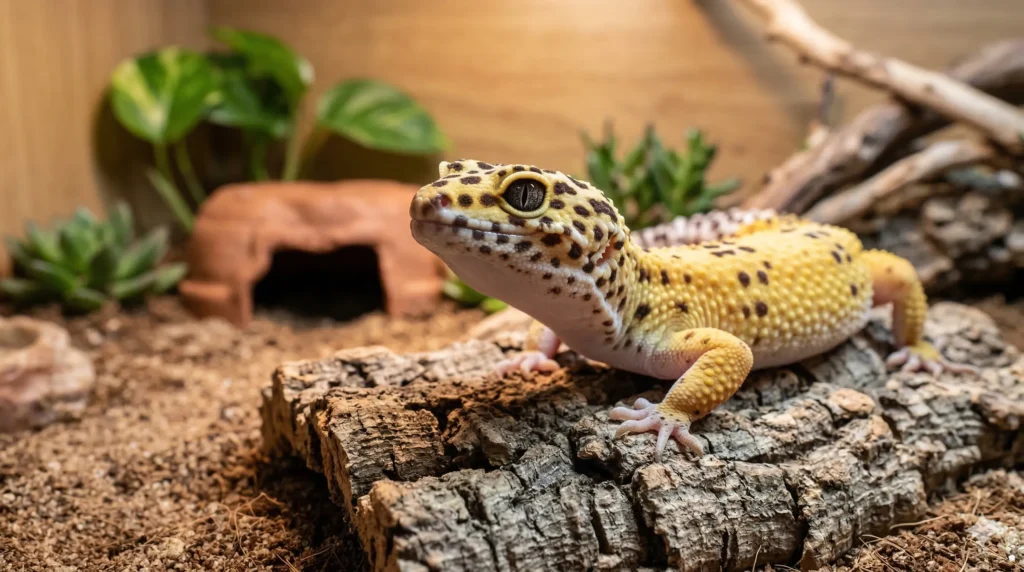
The leopard gecko is consistently ranked as the best reptile for beginners — and for good reason. They are docile, manageable in size, do not require UVB lighting, and communicate their mood clearly. But “beginner-friendly” does not mean low-effort. Leopard geckos live 15–20 years and have specific temperature, feeding, and substrate requirements that, if ignored, cause preventable health problems. Get the setup right from day one and you will have one of the most rewarding reptile companions available.
Leopard geckos need a 20-gallon+ tank with a warm hide (88–92°F), a cool hide (72–78°F), and a humid hide for shedding. They eat live insects only (no vegetables), need calcium with D3 dusted on every other feeding, and should be handled for no more than 15 minutes per session until fully tame. They live 15–20 years with proper care.
Quick Stats
- Lifespan: 15–20 years (up to 25 in exceptional cases)
- Adult size: 7–10 inches, 45–65 grams
- Temperament: docile, slow-moving, curious
- Activity: nocturnal (most active at dusk and night)
- Beginner rating: excellent
- Requires UVB lighting: no (though low-level UVB is now recommended by many vets)
- Requires live food: yes — will not eat dead insects in most cases
Enclosure Setup
Tank Size
A 20-gallon long tank (30″ x 12″ x 12″) is the minimum for one adult leopard gecko. A 40-gallon breeder tank (36″ x 18″ x 18″) is preferred and provides space for the full hide setup, enrichment, and better temperature gradients.
Never house two males together — they will fight. Two females can coexist if the enclosure is large enough (40+ gallons) with duplicate hides. Do not house males with females unless breeding is the deliberate goal — males cause significant stress in females.
The Three-Hide System (Non-Negotiable)
The three-hide system is not optional — it is the foundation of leopard gecko welfare.
- Warm hide: placed directly over the heating element on the warm end. Inside temperature 88–92°F. Snug-fitting (the gecko should touch all sides).
- Cool hide: on the cool end, same snug size. Provides security at ambient temperature.
- Humid hide: on the warm side or middle, lined with damp sphagnum moss or paper towels. Maintained at 70–80% humidity. Critical for healthy shedding — without it, stuck sheds on the toes cause constriction and toe loss.
Temperature and Heating
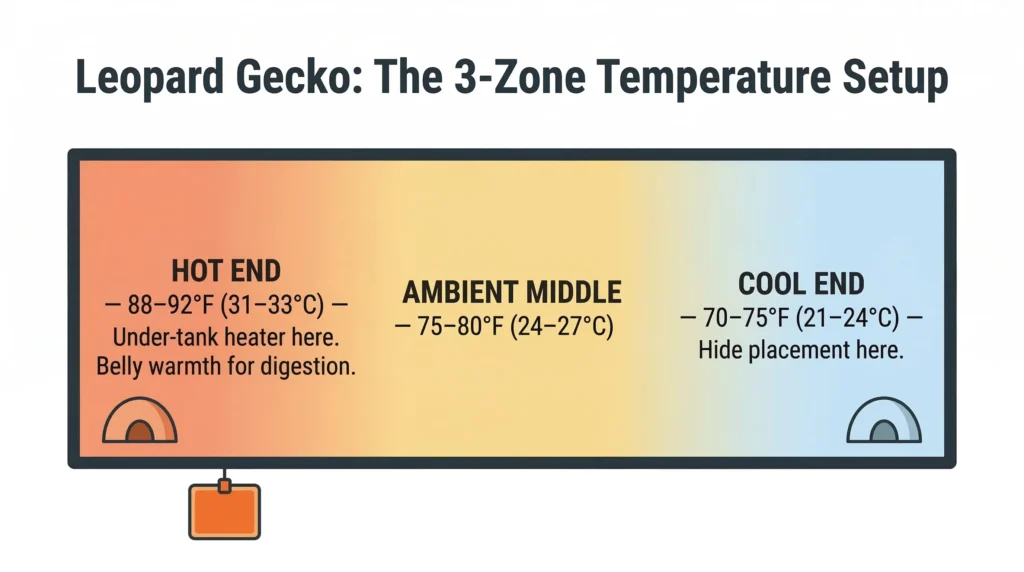
Temperature Gradient
| Zone | Target Temperature | Method |
|---|---|---|
| Warm side surface (belly heat) | 88–92°F (31–33°C) | Under-tank heater (UTH) with thermostat |
| Warm side ambient (air) | 80–85°F (27–29°C) | Room temperature + UTH |
| Cool side ambient | 72–78°F (22–25°C) | Natural room temperature |
| Nighttime low | No lower than 65°F (18°C) | Ceramic heat emitter if room gets cold |
CRITICAL: All heating elements must be connected to a thermostat. An unregulated UTH can reach 120°F+ and cause fatal thermal burns — the gecko cannot feel heat through its belly the way mammals do.
Lighting
Leopard geckos are nocturnal and do not require UVB as strictly as many other reptiles. However:
- Low-level UVB (2.0 or 5.0 UVB bulb on a 12-hour cycle) is now recommended by most reptile vets for improved calcium metabolism and overall wellbeing.
- Never use red or blue “night” bulbs — geckos can see these and they disrupt the day-night cycle.
- A basic LED or low-wattage daylight bulb on a 12-hour timer provides the light cycle the gecko needs to regulate behaviour.
Substrate
Best options:
- Tile (ceramic or slate): easiest to clean, maintains belly temperature well, safe for juveniles
- Paper towels: quarantine and juvenile geckos only
- Bioactive mix (40% organic topsoil, 40% sand, 20% coconut fibre): excellent for adults, mimics natural environment, self-cleaning with isopods
AVOID: loose calcium sand (causes impaction), reptile carpet (bacteria trap, catches toes), and walnut shell (impaction risk, sharp edges).
Feeding
What Leopard Geckos Eat
Leopard geckos are insectivores — they eat only live insects. They do not eat vegetables, fruit, or pre-killed insects in most cases.
Feeder Insects
| Feeder Insect | Nutritional Value | Notes |
|---|---|---|
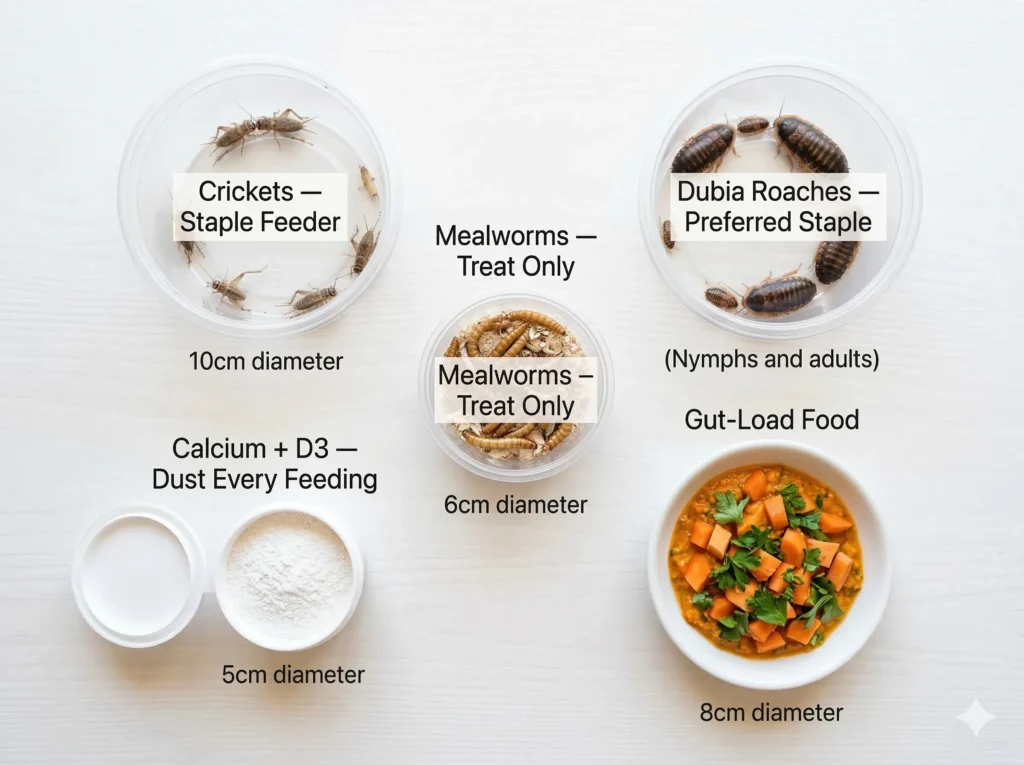
| Crickets | High protein, good staple | Gut-load 24 hours before feeding; can bite the gecko if left overnight |
| Dubia roaches | Excellent — high protein, soft body | Best staple feeder; cannot climb or fly, low odour |
| Mealworms | Moderate — high fat | Occasional treat only; high fat content if fed as staple |
| Superworms | High fat | Treats only; can bite; not for juveniles |
| Waxworms | Very high fat | Maximum 1–2 per week; like candy for geckos — highly palatable but nutritionally poor |
| Black soldier fly larvae (BSFL) | Excellent calcium-to-phosphorus ratio | Excellent supplemental feeder |
Feeding Schedule
- Juveniles (under 6 months): daily, 5–7 appropriately sized insects
- Sub-adults (6–12 months): every other day, 5–7 insects
- Adults (12+ months): every 2–3 days, 4–6 insects
- Rule of thumb: insects should be no larger than the space between the gecko’s eyes
Supplementation (Critical)
Leopard geckos cannot synthesise calcium without supplementation. Without it, they develop metabolic bone disease (MBD) — a progressive, painful, and eventually fatal condition.
- Calcium with D3: dust every other feeding
- Plain calcium (no D3): leave a small bottle cap of loose powder in the enclosure at all times — the gecko will self-regulate
- Multivitamin (Repashy or Herptivite): once every 1–2 weeks in addition to calcium
Handling and Temperament
- Begin handling sessions at 5–10 minutes, once daily
- Support the full body — never grab the tail (it can drop as a defence mechanism; it grows back but unevenly)
- Hand movement should be slow and predictable
- A relaxed gecko: moves slowly, tongue-flicks curiously, body low and relaxed
- A stressed gecko: tail waving (warning), vocalising, attempting to flee, or mouth-gaping (threat display)
- Never handle within 48 hours of feeding (risk of regurgitation) or during a shed
Tail dropping (autotomy): a leopard gecko that drops its tail is not injured — the tail detaches as a defence mechanism. The wound is self-sealing. The tail will regrow over 6–12 months but as an irregular fatty lump, not the original pattern. Keep the enclosure extra clean during regrowth.
Health — Common Problems and Prevention
Health Issues
| Condition | Signs | Cause | Action |
|---|---|---|---|
| Metabolic Bone Disease (MBD) | Rubbery jaw, tremors, difficulty walking, curved spine | No calcium or D3 supplementation | Vet immediately; injectable calcium; correct supplementation protocol |
| Stuck shed (dysecdysis) | Retained skin on toes, tail tip, eyes | Humid hide absent or too dry | Warm water soak 20 minutes; gentle removal; check humid hide |
| Crypto (Cryptosporidiosis) | Weight loss despite eating, watery stools, “stick tail” | Cryptosporidium parasite; incurable | Vet for diagnosis; strict isolation; consider euthanasia for welfare |
| Impaction | Constipation, bloating, straining | Loose substrate ingestion or large prey items | Warm soaks, gentle belly massage; vet if no result in 48h |
| Respiratory infection | Wheezing, mucus, open-mouth breathing | Low temperature + high humidity | Vet and antibiotic treatment; correct temperatures |
| Mouth rot (stomatitis) | Redness, swelling, cottage-cheese discharge in mouth | Injury + bacterial infection | Vet for antibiotic treatment; correct husbandry |
Frequently Asked Questions
How long until a leopard gecko is tame enough to handle?
Most captive-bred leopard geckos become comfortable with handling within 2–4 weeks of consistent short sessions. Wild-caught individuals (now rare) take significantly longer. Always move at the gecko’s pace — forcing handling creates stress and can result in tail drops and a permanently skittish gecko.
Why is my leopard gecko not eating?
The most common causes are: shedding (geckos often refuse food for several days before and during a shed), low temperatures (below 85°F warm side = impaired digestion), stress from a new environment (allow 1–2 weeks of low-disturbance settling-in time), or illness. Crypto (Cryptosporidiosis) causes dramatic weight loss alongside food refusal and requires urgent vet attention.
Do leopard geckos need a water bowl?
Yes — always. A shallow water dish on the cool side should have fresh, dechlorinated water available at all times. Change daily. The gecko may not drink visibly but does need access to water.
Can leopard geckos live together?
Only females, in a large enough enclosure (40+ gallons) with duplicate hides for each gecko. Males fight lethally. Male-female pairs result in constant male harassment and breeding stress on the female. Cohabitation is generally not recommended for welfare reasons even among females.
Sources
- Reptiles Magazine — Leopard Gecko Care: reptilesmagazine.com
- Royal Society for the Prevention of Cruelty to Animals — Leopard Gecko Care: rspca.org.uk
- Merck Veterinary Manual — Reptile Nutrition and Husbandry
- Society for the Study of Amphibians and Reptiles: ssarherps.org