
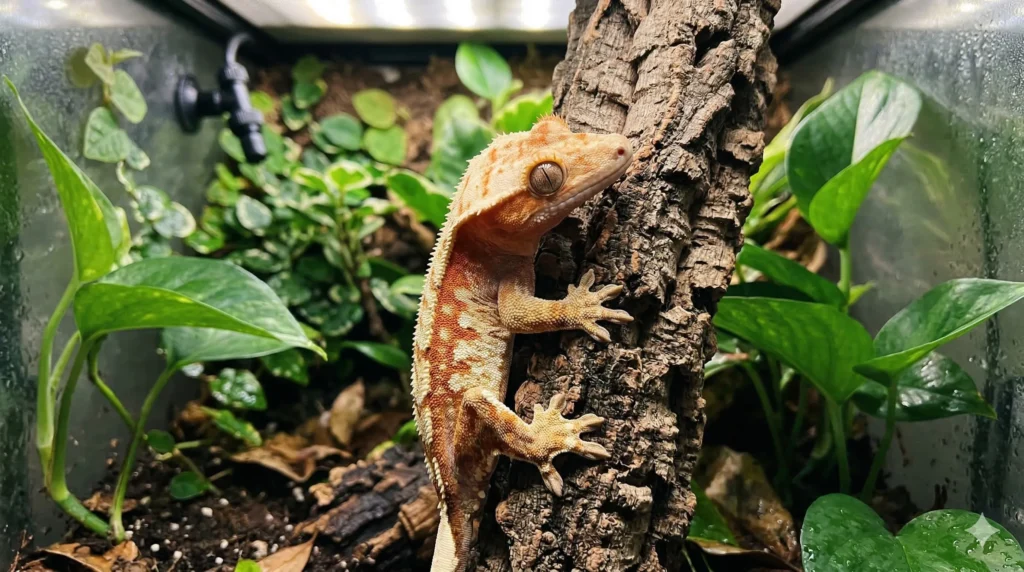
The crested gecko was thought to be extinct until its rediscovery in 1994 — and today it is one of the most popular pet reptiles in the world. It is easy to see why: they are handleable, visually stunning, tolerate room temperature without complex heating, eat a commercially prepared diet, and rarely bite. For a first reptile, they are nearly ideal. This guide covers everything you need to keep one successfully for their full 15–20 year lifespan.
Crested geckos need a tall, well-ventilated enclosure (18″x18″x24″ minimum), temperatures of 72–78°F, and a diet of commercial crested gecko meal replacement powder (Pangea or Repashy) supplemented with live insects. They are nocturnal, do not need UVB lighting (though it is beneficial), and can drop their tails — unlike leopard geckos, the tail does not regrow.
Quick Stats
- Lifespan: 15–20 years
- Adult size: 7–9 inches (including tail), 35–55 grams
- Temperament: generally docile, though individuals vary
- Activity: nocturnal — most active after lights out
- Beginner rating: excellent
- Requires UVB: not mandatory, but beneficial
- Diet: primarily commercial meal replacement powder (MRP) + live insects
Enclosure Setup
Tank Size and Orientation
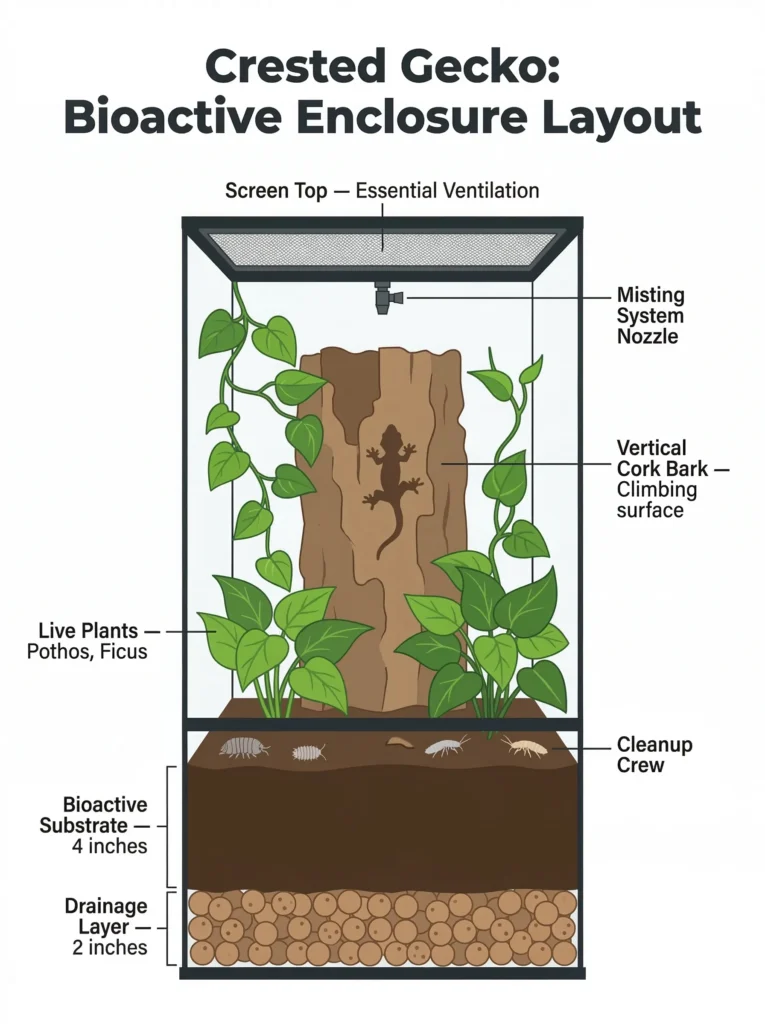
Crested geckos are arboreal — they live in trees. Unlike leopard geckos, they need height more than floor space. Minimum enclosure size: 18″ x 18″ x 24″ (tall format). For an adult, 18″ x 18″ x 36″ is ideal.
The best enclosure types are front-opening mesh or glass vivariums — screen sides provide ventilation; front opening allows feeding and cleaning without disturbing from above (which terrifies arboreal geckos).
Do not house males together — they fight. Two females can share a 30+ gallon tall enclosure with duplicate hides and feeding stations. Male-female pairs will breed — remove eggs every 4–6 weeks if breeding is not the goal.
Décor and Enrichment
Crested geckos thrive in planted enclosures. Live or artificial plants, cork bark tubes, bamboo branches, and hanging vines all serve both as hiding spots and climbing structure.
- Cover at least 50% of the enclosure walls with plants and cork bark
- Provide multiple climbing levels — geckos use the full height
- Include at least 2 hides: one high up and one near the bottom
- A lay box (plastic container with damp coconut fibre) is needed for females — they will lay infertile eggs regardless of male presence
Temperature
Temperature
| Zone | Target | Method |
|---|---|---|
| Daytime ambient | 72–78°F (22–25°C) | Room temperature in most homes |
| Nighttime | 65–72°F (18–22°C) | Room temperature |
| Maximum tolerable | 80°F (27°C) — brief only | — |
| Danger zone | Above 85°F (29°C) | Fatal within hours |
CRITICAL: Crested geckos cannot tolerate heat above 80°F for prolonged periods. In summer, this is the most common cause of sudden death. Monitor room temperature during warm months and use a fan or air conditioning if needed — not a heat lamp. If your room exceeds 78°F regularly, reconsider crested gecko ownership until cooling is available.
Humidity
Target: 60–80% with a nightly spike. The best approach: mist the enclosure heavily at lights-out, allow it to dry to 50–60% during the day. This mimics the natural cycle of humid nights and drier daytime hours in New Caledonia (their native habitat).
- Mist one side of the enclosure heavily each night — leave the other side drier so the gecko can thermoregulate moisture exposure
- Include a small humid hide with damp sphagnum moss for shedding
- Ensure good ventilation so the enclosure does not stay saturated — stagnant wet conditions cause bacterial infections and respiratory disease
Diet
The Meal Replacement Powder (MRP) System
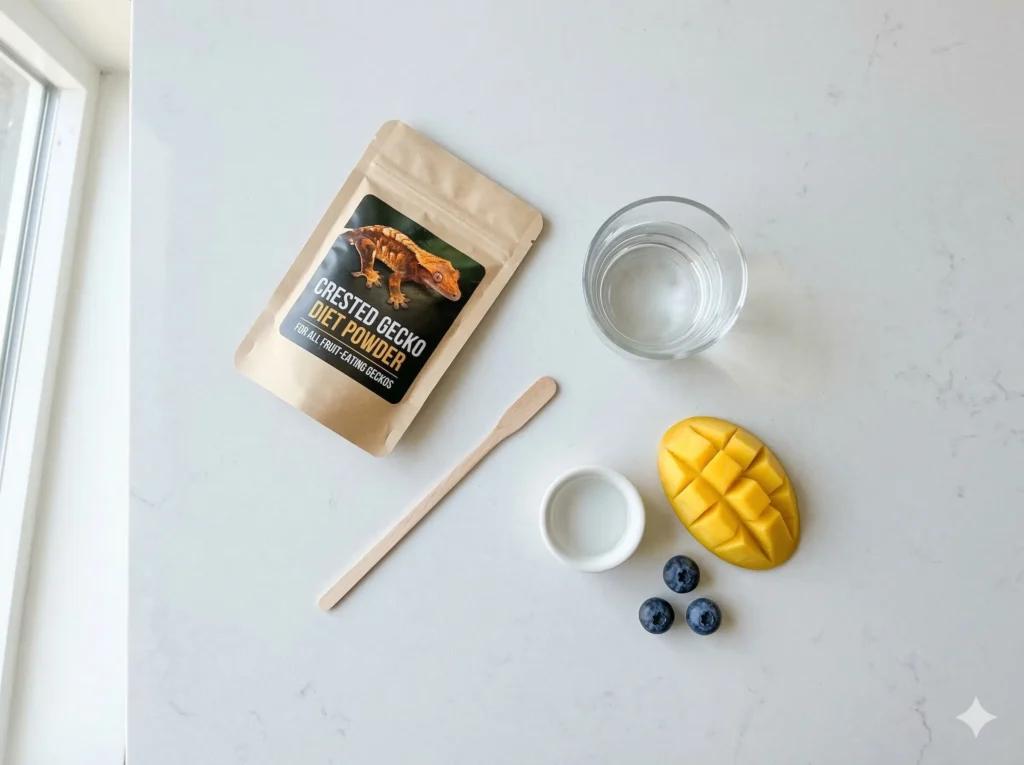
Crested geckos are one of the few reptiles that thrive on a commercially prepared complete diet. Pangea and Repashy Crested Gecko MRPs are the two most widely used and respected formulas — both are nutritionally complete when used as directed.
How to prepare: mix powder with water to a smooth consistency (similar to Greek yogurt). Offer in a small shallow dish, clipped to the side of the enclosure. Replace every 24 hours — MRP spoils quickly.
- Offer MRP every other day for juveniles; 3x per week for adults
- Rotate flavours (mango, fig, watermelon) to prevent flavour fatigue
- Do not add supplements to MRP — it is already complete
Live Insects
MRP alone is sufficient for survival, but live insects significantly improve health, growth rate, and stimulate natural hunting behaviour.
Offer live insects 1–2 times per week: crickets and Dubia roaches are the best options. Dust with plain calcium (not calcium + D3 — the MRP already contains D3, excess can cause toxicity). Size rule: no insect larger than the space between the gecko’s eyes.
Fruit (Optional Supplement)
Small amounts of mashed ripe fruit (mango, papaya, fig, pear) can be offered as an occasional enrichment treat — no more than once per week. Avoid citrus. Never substitute fruit for MRP — it is not nutritionally adequate.
Water
Always provide fresh water in a shallow dish on the floor of the enclosure. Crested geckos also drink water droplets from the plant leaves after misting. Both are important — do not rely on one alone.
Handling
- Wait 2 weeks after bringing a new gecko home before handling — allow full acclimation
- First sessions: 5 minutes only, once per day
- Crested geckos move quickly in jumps — always handle close to a soft surface or sitting on the floor
- The jump-and-move method: let the gecko walk from hand to hand; do not restrain
- A relaxed gecko: explores hands calmly, tongue-flicks, moves at a measured pace
- A stressed gecko: flattens, vocalises (chirp or squeak), tail waves, or leaps to flee
Tail dropping: crested geckos can and do drop their tails when very stressed. Unlike leopard geckos, the tail does NOT regrow. “Frog-butted” tailless crested geckos are healthy and common — the loss is cosmetic. Minimise stress handling to reduce the chance of this occurring, especially with juveniles.
Health — Common Issues
Health Issues
| Condition | Signs | Cause | Action |
|---|---|---|---|
| Floppy tail syndrome | Tail hangs to one side permanently | Calcium deficiency or genetics | Correct diet; vet assessment for MBD |
| Stuck shed | Retained skin, especially on toes | Insufficient humid hide or low humidity | Warm water soak; gentle removal |
| Respiratory infection | Wheezing, open-mouth breathing, mucus | Sustained low temperature + poor ventilation | Reptile vet and antibiotic treatment |
| Parasites | Weight loss, lethargy, abnormal droppings | Common in wild-caught; sometimes captive-bred | Faecal test at reptile vet |
| Overheating | Lethargy, unresponsiveness, open-mouth breathing | Room temperature above 82°F | Move to cool room immediately; mist lightly; vet if unresponsive |
| Egg binding (females) | Bloating, straining, lethargy in female | No lay box available | Vet immediately — egg binding is fatal if untreated |
Frequently Asked Questions
Do crested geckos need UVB lighting?
Not strictly — they can survive and reproduce without it. However, recent research shows that low-level UVB (5.0 or 6% UVB bulb on a 10–12 hour cycle) improves bone density, immune function, and overall activity levels. If you are setting up a new enclosure, including low-level UVB is now the recommended best practice.
How often should I feed a crested gecko?
Offer MRP every 1–2 days for juveniles, every 2–3 days for adults. Live insects once or twice per week. Remove and replace MRP after 24 hours — it ferments quickly and spoils. Never leave old food in the enclosure.
Why is my crested gecko not eating?
Most common causes: too cold (below 65°F reduces appetite), shedding (geckos often stop eating for a few days before and during a shed), food fatigue (rotate MRP flavours), or stress from a new environment. A gecko that has gone more than 3 weeks without eating should be assessed by a reptile vet.
Can crested geckos live together?
Females can coexist in a large enough enclosure (30+ gallon tall) with adequate hides and duplicate feeding stations. Males will fight. Male-female pairs will breed constantly — stressful for the female. Cohabitation is generally not recommended unless you have significant reptile experience.
Sources
- Reptiles Magazine — Crested Gecko Care Guide: reptilesmagazine.com
- Pangea Reptile — Crested Gecko Nutrition: pangeareptile.com
- Merck Veterinary Manual — Reptile Husbandry
- New Caledonia Biodiversity Portal — Rhacodactylus ciliatus ecology: biodiversity.nc