
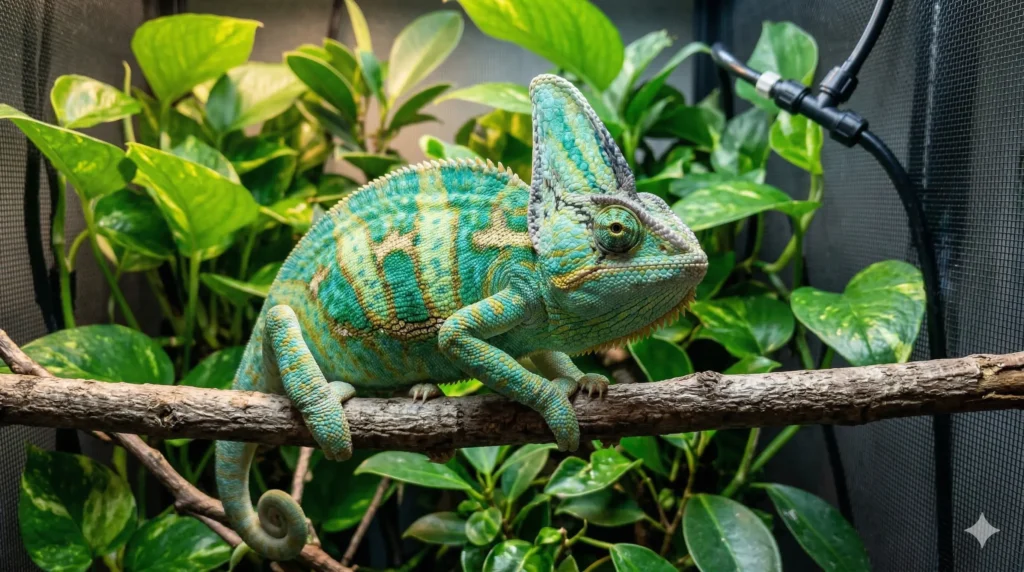
Chameleons are arguably the most visually spectacular reptiles in the pet trade. They are also among the most demanding, most stress-sensitive, and most frequently killed by well-intentioned beginners who underestimated what they were taking on. The most commonly kept species — the Veiled Chameleon (Chamaeleo calyptratus) and the Panther Chameleon (Furcifer pardalis) — have an average lifespan of 3–7 years in captivity, but many kept by beginners die within the first year. This guide tells you exactly why, and what it takes to clear the five hardest hurdles.
Chameleons are not beginner-friendly because they require precise UVB lighting, a live-plant screen enclosure with perfect ventilation, a drip watering system (they do not drink from bowls), daily gut-loaded live insect feeding, and zero tolerance for stress from handling or a poor environment. They cannot communicate distress until they are critically ill. If you are a first-time reptile owner, start with a leopard gecko or crested gecko first.
The Reality of Chameleon Ownership — The Data
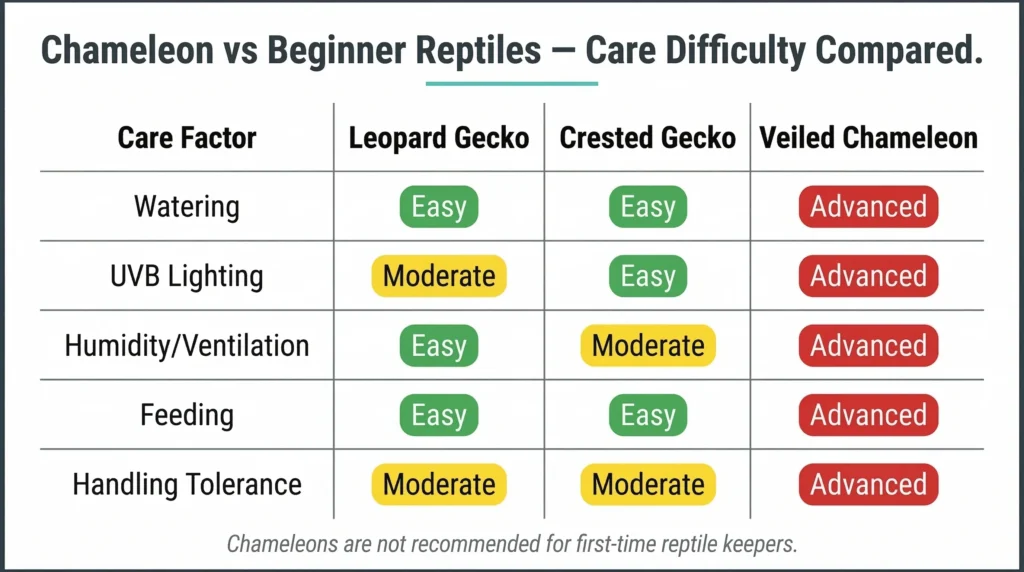
The average lifespan of a wild Veiled Chameleon is 5–8 years. In well-managed captivity, experienced keepers achieve 6–8 years. The average under beginner care is reported by reptile veterinarians to be under 12–18 months. This is not because chameleons are fragile — it is because their needs are very specific and the consequences of getting them wrong are fatal, often before the keeper realises there is a problem.
Hurdle 1 — They Will Not Drink from a Water Bowl
This is the single most common reason chameleons die in captivity and one of the easiest to miss. Chameleons evolved in forest environments where water appears as droplets on leaves after rain or morning dew. They do not recognise a still water surface as a water source and will dehydrate to death next to a full water bowl.
What they need: a continuous drip system or automatic misting system that produces water droplets on the leaves and mesh walls of the enclosure. The chameleon drinks by licking droplets off surfaces.
Watering Methods
| Method | Effectiveness | Notes |
|---|---|---|
| Hand misting (spray bottle) | Moderate | Minimum 3–4 times daily, 2–3 minutes each; labour intensive and easy to miss |
| Drip system | Good | A container with a slow drip onto leaves; must drain properly to avoid standing water |
| Automatic misting system | Best | Programmable, consistent; 60-90 second misting cycles, 4-6 times daily; easiest for beginners willing to invest |
| Water dripper (store-bought) | Good | Designed specifically for chameleons; drips at a steady rate onto a leaf above the feeding zone |
- Signs of dehydration: sunken eyes, wrinkled skin, dark colours even when warm and unstressed, lethargy, sticky tongue tip
- A dehydrated chameleon is a medical emergency — do not wait and see
Hurdle 2 — Ventilation Is Non-Negotiable
Chameleons come from environments with constant air movement. Unlike most reptiles that do well in sealed glass enclosures, a chameleon in a glass tank with poor ventilation develops respiratory infections rapidly. Screen enclosures are mandatory — all four sides should be screened, not just the top.
The correct enclosure type: all-screen mesh enclosure (aluminium or fibreglass mesh). Minimum sizes:
- Veiled Chameleon (adult): 24″x24″x48″ (tall)
- Panther Chameleon (adult): 24″x24″x48″ (tall)
- Juveniles: 16″x16″x30″ until 4–5 months, then upgrade
Glass tanks, aquariums, and poorly ventilated terrariums are not acceptable for chameleons regardless of what pet shops sell. The consequence of insufficient ventilation is URI (upper respiratory infection) — a recurring and expensive condition.
Plants inside the enclosure serve a dual purpose: they provide cover (reducing stress) and catch water droplets (creating drinking surfaces). Pothos, Ficus, Hibiscus, and Schefflera are all safe and effective.
Hurdle 3 — UVB Is Not Optional
Chameleons require high-output UVB lighting — not the low-level UVB that benefits leopard or crested geckos, but meaningful UVB that replicates the intensity of tropical sunlight.
- Correct bulb: linear T5 HO UVB (Arcadia 6% or 12%, or Zoo Med Reptisun 10.0)
- Placement: within 8–12 inches of the basking zone inside the enclosure
- Duration: 10–12 hours daily on a timer
- Replacement: every 6 months — UVB output declines before the bulb stops producing visible light
Without adequate UVB:
- Calcium cannot be metabolised correctly
- Metabolic Bone Disease (MBD) develops — bones soften, jaw becomes rubbery, the animal cannot feed, climb, or function
- MBD is irreversible beyond a certain point and causes suffering
Supplementation alone cannot replace UVB. Both are needed: a full-spectrum UVB source AND calcium with D3 dusted on feeders.
Hurdle 4 — They Eat Live Insects Only, Daily
Chameleons are ambush predators that hunt live prey by tracking movement. A dead insect does not trigger the feeding response in most chameleons, and pre-killed or freeze-dried insects are not suitable staples.
Daily feeding (adults): 8–12 appropriately sized live insects for juveniles; 6–10 every 1–2 days for adults.
Feeder Insect Guide
| Feeder | Notes |
|---|---|
| Crickets | Staple; must be gut-loaded 24 hours before feeding; ensure none escape into the enclosure overnight (they can bite sleeping chameleons) |
| Dubia roaches | Excellent nutrition; do not gut-load differently than crickets; cannot climb or fly |
| Black soldier fly larvae | High calcium naturally; excellent supplemental feeder |
| Hornworms | High water content; excellent for hydration; treat status only (high water dilutes nutrition if overfed) |
| Waxworms | Treats only; high fat |
| Mealworms | Occasional only; hard chitin difficult to digest in quantity |
Gut-loading is not optional: the insect you feed is only as nutritious as what it ate. Feed your feeder insects fresh leafy greens, sweet potato, and commercial gut-load for 24 hours before offering them to the chameleon.
Supplementation schedule (Veiled and Panther):
- Calcium without D3: every feeding
- Calcium with D3: twice monthly
- Multivitamin: twice monthly
Hurdle 5 — They Are Extremely Stress-Sensitive
This is the hurdle that defeats the most experienced keepers. Chameleons are not animals that enjoy or tolerate being handled. They are solitary, territorial animals that in the wild live alone in a tree and interact with other chameleons only to mate and fight. The act of being held by a human registers as predator contact and triggers a sustained stress response.
What chronic stress looks like in a chameleon:
- Persistently dark colours regardless of temperature
- Refusing to eat
- Gaping mouth (threat display) whenever approached
- Hiding at the bottom of the enclosure
- Weight loss
- Death from stress-related immune suppression and secondary infection
Sources of stress that kill chameleons:
- Seeing their own reflection (mirrors, shiny surfaces near the enclosure)
- Being able to see other chameleons (or other animals perceived as threats)
- Excessive handling — even once daily is too much for most individuals
- Inadequate hiding spots (chameleons need dense plant cover to feel invisible)
- Enclosure placed in a high-traffic area of the home
- Loud music, TV, or vibration near the enclosure
Stress management rules:
- Place the enclosure in a low-traffic, quiet room
- Fill the enclosure with enough live plants that the chameleon can completely disappear from view
- Handle only for vet visits or when genuinely necessary — not as a daily interaction
- No other pets should be able to see or approach the enclosure
Signs Your Chameleon Is Sick (They Hide It Until It Is Critical)
Chameleons are prey animals. In the wild, a visibly sick chameleon is a dead chameleon. They conceal illness until they are critically unwell — by which point treatment is much harder and often too late.
Act immediately if you see:
- Persistent dark colours or black patches with no improvement
- Eyes that are closed, sunken, or asymmetric during the day
- Weight loss — ribs visible, hip bones prominent, casque appearing larger due to head shrinkage
- Open-mouth breathing or wheezing
- Swollen limbs or jaw
- Inability to aim the tongue accurately when feeding (neurological/MBD sign)
- Complete food refusal for more than 1 week in an adult
Frequently Asked Questions
What is the easiest chameleon for a beginner?
The Veiled Chameleon is the most robust and forgiving species for beginners with some reptile experience — not true beginners. It tolerates a broader temperature and humidity range than Panther Chameleons. Jackson’s Chameleons are sometimes recommended for cooler climates and are slightly less demanding on heat, but still require the same humidity, UVB, and stress management protocols.
Can you keep two chameleons together?
No — never. Chameleons are solitary and will fight to the death if housed together. Even visual contact between two chameleons through separate enclosures causes significant chronic stress. Each chameleon needs its own enclosure in a space where it cannot see other chameleons.
How do I know if my chameleon is dehydrated?
Sunken eyes are the most reliable sign — the eyes appear to be set deeper in their sockets than normal. Other signs include wrinkled skin, very yellow or orange-coloured urine (urates), lethargy, and darker-than-normal colouring. Increase misting immediately and see a reptile vet if the chameleon does not improve within 24 hours.
Why does my chameleon keep its eyes closed?
Closed eyes during the day in a chameleon that is not sleeping is always a serious sign. It indicates the animal is unwell — possible causes include dehydration, respiratory infection, metabolic bone disease, or a severe vitamin A deficiency. See a reptile vet same day.
Sources
- Chameleon Academy — Veiled and Panther Chameleon Care: chameleonacademy.com
- Reptiles Magazine — Chameleon Care and Health: reptilesmagazine.com
- Merck Veterinary Manual — Lizard Husbandry and Disease
- Association of Reptilian and Amphibian Veterinarians: arav.org