
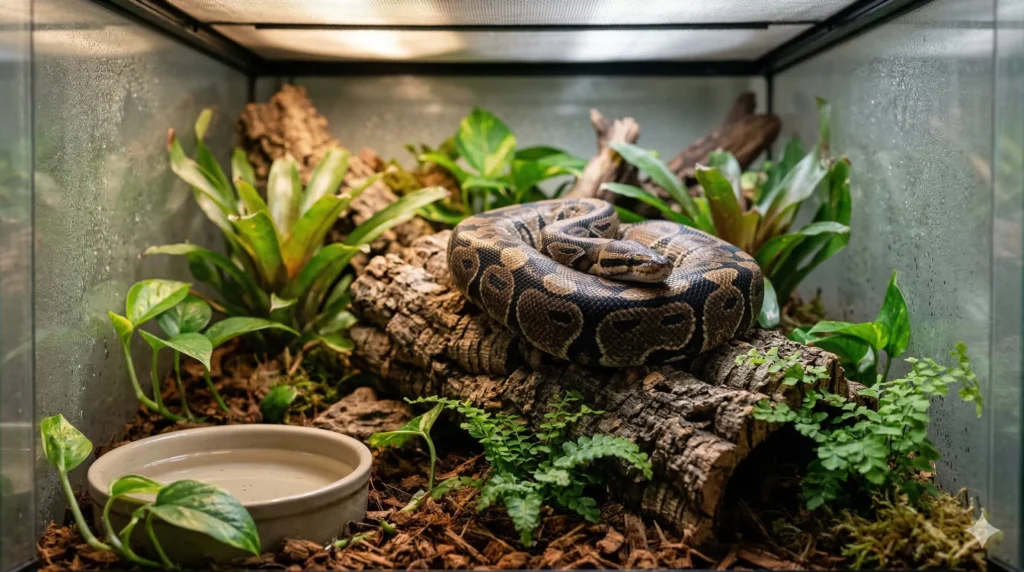
Ball python humidity is the single most mismanaged aspect of ball python husbandry — and the one that causes the most health problems. Too low, and your snake gets stuck sheds, dehydration, and respiratory irritation. Too high for too long, and you risk scale rot and respiratory infection. The target is 60–80%, with spikes up to 90% during shedding. This guide shows you exactly how to hit that range consistently in any enclosure type.
Ball pythons need 60–80% relative humidity at all times, rising to 80–90% during shedding (pre-shed through completion). The best tools are a digital hygrometer, a moisture-retaining substrate (coconut fibre, cypress mulch, or bioactive mix), and a fogger or misting schedule. Screen-top enclosures lose humidity fastest and need the most management.
Why Humidity Is Non-Negotiable for Ball Pythons
Ball pythons originate from the forests and grasslands of West and Central Africa — environments that maintain 60–80% relative humidity year-round with seasonal spikes during the rainy season. Their bodies are calibrated for this range:
- Respiratory tract: requires ambient moisture to stay healthy. Dry air causes the mucus membranes to dry out, creating an environment where bacterial respiratory infections thrive.
- Skin and scales: the outermost layer of skin needs adequate hydration to shed in one complete piece. Low humidity causes incomplete sheds (dysecdysis) — retained eye caps are the most dangerous complication.
- Kidney function: ball pythons in low-humidity environments become chronically mildly dehydrated, stressing the kidneys over time.
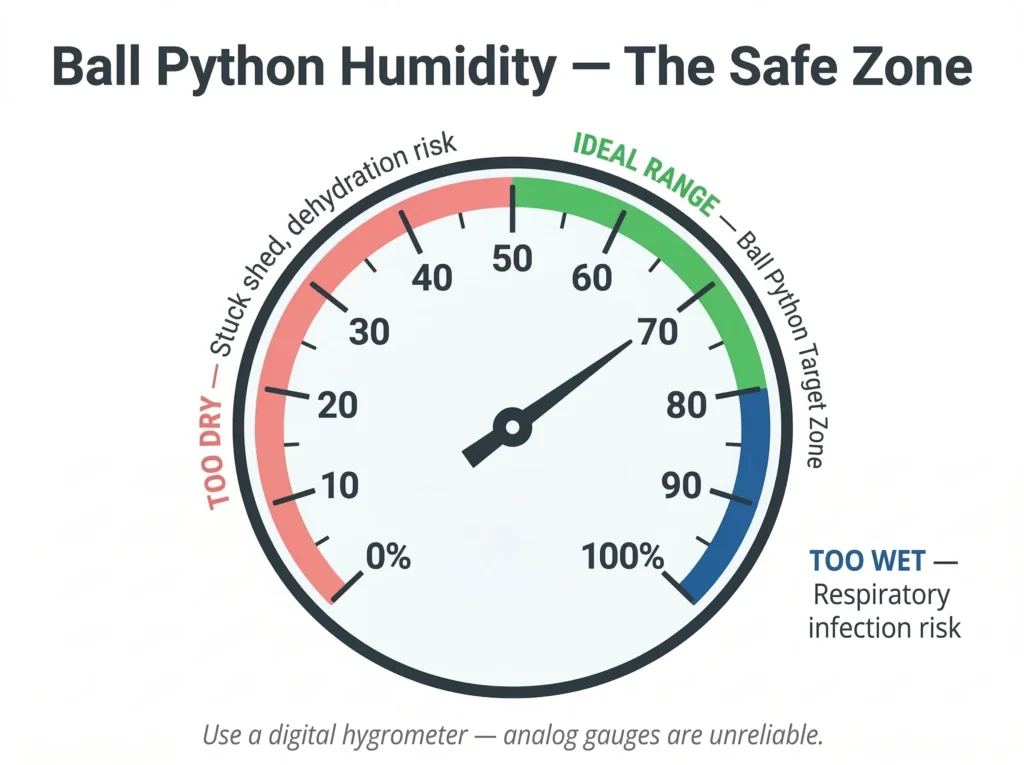
The Humidity Levels at Every Stage
| Stage | Target Humidity | Notes |
|---|---|---|
| Normal / daily | 60–70% | Comfortable range for feeding, activity, and rest |
| Elevated baseline | 70–80% | Recommended for hatchlings and juveniles, who are more sensitive |
| Pre-shed (eyes turn blue) | 75–85% | Increase humidity as soon as blue eye caps are noticed |
| Active shed | 80–90% | Peak humidity needed for a clean one-piece shed |
| Post-shed | Return to 60–70% | Reduce humidity after shed is confirmed complete |
| Too high (danger zone) | Above 90% sustained | Risk of scale rot and respiratory infection |
How to Measure Humidity Correctly
Never rely on analogue dial hygrometers — they are notoriously inaccurate. Use a digital hygrometer with a remote probe.
- Place the probe in the middle of the enclosure, not directly over the water bowl
- Check readings at the warm end and the cool end — they will differ by 5–10%
- Record readings morning and evening for 3–7 days to understand your baseline before making changes
- Calibrate: place the hygrometer in a sealed bag with a damp paper towel for 30 minutes — it should read 95–100%. If it reads significantly different, adjust your baseline expectations accordingly.
Recommended: any digital hygrometer with a remote probe — brands such as Govee, ThermoPro, or Inkbird are affordable and reliable.
The Best Substrates for Maintaining Humidity
Substrate choice is the most powerful lever for humidity management.
| Substrate | Humidity Retention | Safety | Notes |
|---|---|---|---|
| Coconut fibre (coir) | Excellent | Safe | Best for beginners; retains moisture well, cheap, widely available |
| Cypress mulch | Excellent | Safe | Natural look, holds humidity very well, resists mould |
| Bioactive mix (coir + sand + organic topsoil) | Excellent | Safe | Best long-term option; self-sustaining with isopods and springtails |
| Sphagnum moss (as top layer) | Exceptional | Safe | Perfect for humid hides and shedding boxes; holds moisture up to 20x its weight |
| Paper towels / newspaper | None | Safe | Quarantine only — no humidity retention whatsoever |
| Aspen shavings | Poor | Safe (dry) | Not suitable for ball pythons — dries out rapidly and causes mould when wet |
| Pine / cedar shavings | None | TOXIC | Never use — aromatic oils are respiratory irritants lethal to reptiles |
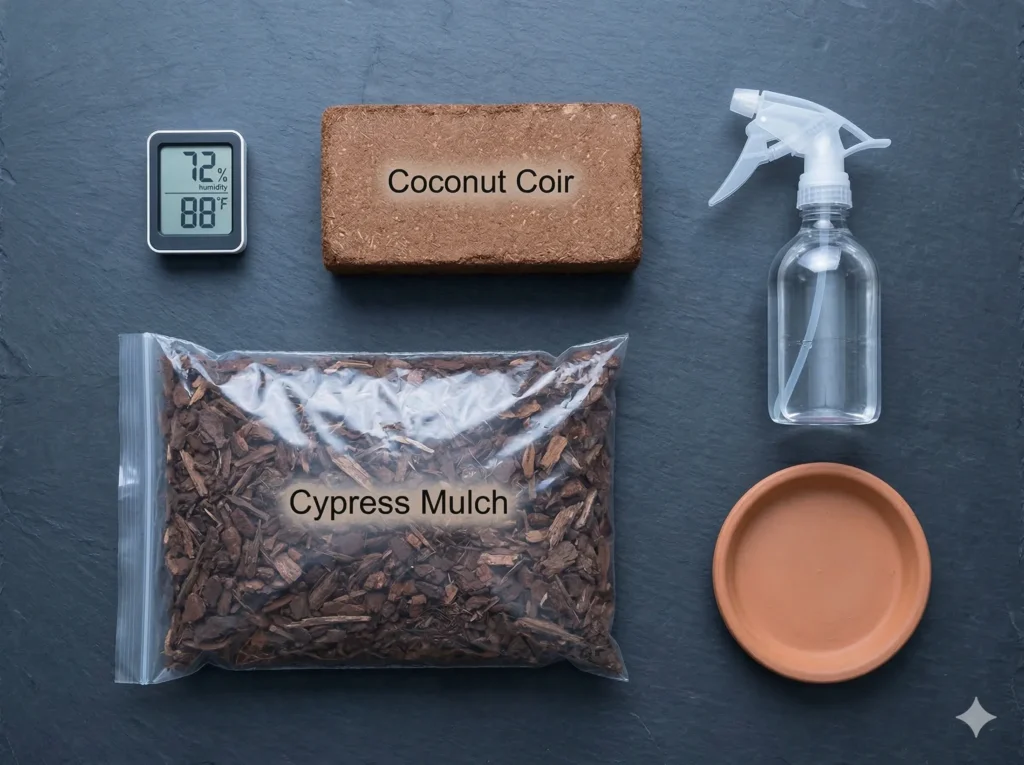
How to Raise Humidity — 7 Methods Ranked
1. Switch to a Moisture-Retaining Substrate (Most Effective)
The substrate is the foundation of your humidity system. 4–6 inches of damp (not soaking) coconut fibre or cypress mulch maintains 60–75% humidity with minimal additional intervention in a well-sealed enclosure. This is the fix for most humidity problems.
How to prep: moisten substrate until it holds its shape when squeezed but does not drip. Spread evenly 4–6 inches deep.
2. Use a Humid Hide
Place a plastic hide box filled with damp sphagnum moss on the warm side of the enclosure. The snake enters to regulate its own humidity as needed — especially valuable during shedding. This is the single most important addition for preventing stuck sheds.
Setup: any opaque plastic container with a hole cut in the lid, half-filled with sphagnum moss dampened until moist but not dripping.
3. Cover Part of the Screen Top
Screen-top enclosures lose humidity rapidly. Cover 50–75% of the screen top with aluminium foil, a piece of PVC board, or a glass panel cut to size. This dramatically reduces moisture evaporation. Start with 50% coverage and increase until you hit your target humidity.
4. Move to a PVC or Glass Enclosure
Front-opening PVC enclosures (Vision Cages, Zen Habitats, Animal Plastics) retain humidity far better than screen-top terrariums. If you are perpetually struggling with humidity in a screen-top, switching enclosure type solves the problem permanently.
5. Mist the Enclosure
Using a hand sprayer or automatic misting system, mist the walls and substrate (not the snake directly) once or twice daily. Misting raises humidity immediately — ideal for shedding periods or if your baseline drops.
Important: ensure the enclosure dries out partially between mistings. Constantly saturated substrate causes mould and scale rot.
6. Use an Ultrasonic Fogger
A fogger placed inside or connected to the enclosure raises ambient humidity significantly. Use a timer to run the fogger for 30–60 minute intervals rather than continuously.
Caution: foggers require daily water changes — stale water in a fogger reservoir rapidly develops bacteria. Use distilled or reverse-osmosis water to prevent mineral buildup.
7. Add a Large Water Bowl
A wide, shallow water bowl placed on the warm side increases evaporative humidity passively. Ball pythons also soak in their water bowl before a shed — this is normal behaviour, not a sign of mites (though mites can also cause excessive soaking; check for tiny moving specks on the snake or in the water).
How to Lower Humidity (If It’s Too High)
Sustained humidity above 90% leads to scale rot (necrotic skin lesions) and respiratory infection.
- Remove the fogger or reduce misting frequency
- Increase ventilation — open more screen panels or add ventilation holes
- Replace wet substrate with dry and allow the enclosure to air out for 24 hours
- Ensure the water bowl is not oversized for the enclosure
- Check for leaks — a crack in the water bowl or a leaking fogger reservoir can silently saturate the substrate
Recognising and Fixing a Bad Shed (Dysecdysis)
A healthy shed comes off in one complete piece including the eye caps (the clearest indicator of success — they look like two small circular pieces of clear skin). A bad shed means the humidity was too low.
| Problem | Likely Cause | Fix |
|---|---|---|
| Shed in multiple pieces | Humidity too low throughout | Raise baseline and add humid hide |
| Retained eye caps | Humidity too low at peak shed | Warm water soak + damp warm cloth gentle pressure |
| Skin stuck around tail tip | Humidity too low, also check for mites | Warm water soak; retained tail skin can cut off circulation — vet if cannot remove |
| Snake rubbing face on enclosure | Normal pre-shed behaviour | No intervention needed; increase humidity |
| Snake refusing food for 2+ weeks | Check for pre-shed (blue eyes, dull skin) | Normal; resume feeding post-shed |
Never pull retained shed skin dry — always soak the snake in shallow warm water (30–32°C) for 20–30 minutes first to loosen the skin. Never attempt to remove retained eye caps without veterinary guidance — the eye can be permanently damaged.
Frequently Asked Questions
How often should I mist my ball python enclosure?
In a well-sealed PVC enclosure with moisture-retaining substrate, once daily or every other day is usually sufficient. Screen-top enclosures may need misting 2–3 times daily to maintain the lower end of the acceptable range. Monitor with a hygrometer and adjust based on readings, not a fixed schedule.
My ball python is soaking in its water bowl constantly — is this normal?
Occasional soaking before a shed is completely normal. Soaking that lasts hours or becomes daily can indicate: enclosure humidity is too low (the snake is compensating), the snake is too warm (check temperatures), or the snake has mites. Inspect the water bowl and the snake carefully for tiny moving specks.
Can I use tap water in the fogger and misting bottle?
Tap water contains chlorine and minerals that can accumulate in the substrate and irritate respiratory tissue over time. Distilled or dechlorinated water is preferred for misting and fogging. A simple dechlorinating tap additive (like those used for fish tanks) is an inexpensive solution.
What temperature should my ball python enclosure be?
Temperature and humidity work together. Warm side: 88–92°F (31–33°C). Cool side: 76–80°F (24–27°C). Ambient air temperature: 78–80°F (25.5–27°C). Use under-tank heating mats with a thermostat — never rely on heat lamps alone, and never use hot rocks.
How do I know if my ball python has a respiratory infection?
Signs include: wheezing or clicking sounds when breathing, mucus around the nostrils or mouth, the snake holding its head up at an angle (stargazing), open-mouth breathing, or lethargy lasting more than a week beyond a shed. Any of these warrants a reptile vet appointment — respiratory infections progress rapidly in ball pythons.
Sources
- Ball Python Care by Reptiles Magazine: reptilesmagazine.com
- Royal Society for the Prevention of Cruelty to Animals — Ball Python Care: rspca.org.uk
- Merck Veterinary Manual — Reptile Husbandry and Nutrition
- American Association of Reptile Keepers: usark.org