
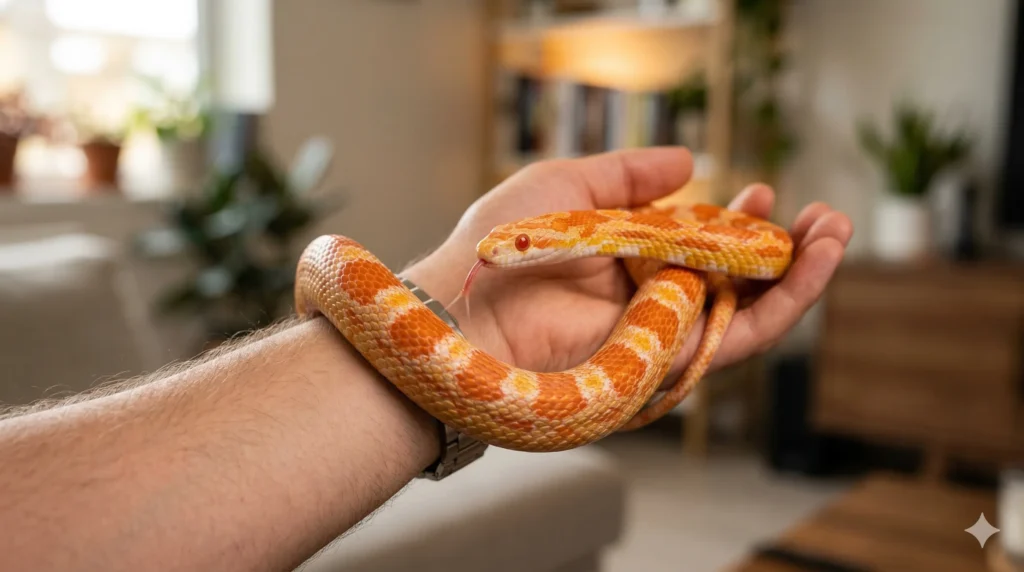
The corn snake is the gold standard first snake for a reason. It is docile, forgiving of beginner mistakes, visually beautiful in dozens of morphs, and has straightforward care requirements that do not require complex lighting or humidity management. They live 15–20 years and reach a manageable adult size of 4–5 feet. Get the basics right and a corn snake is one of the easiest reptile companions you can own.
Corn snakes need a secure escape-proof enclosure (40-gallon minimum for adults), a warm end of 85–88°F and cool end of 72–75°F, and frozen-thawed mice fed every 7–10 days for adults. They are escape artists — always check lid security. Humidity should be 40–60%, rising to 65–75% during shedding.
Quick Stats
- Lifespan: 15–20 years
- Adult size: 4–5 feet (120–150 cm), occasionally 6 feet
- Temperament: docile, calm, tolerates handling well
- Activity: primarily crepuscular and nocturnal
- Beginner rating: excellent
- Diet: frozen-thawed rodents (mice)
- Humidity: 40–60% normal; 65–75% during shed
Enclosure Setup
Tank Size
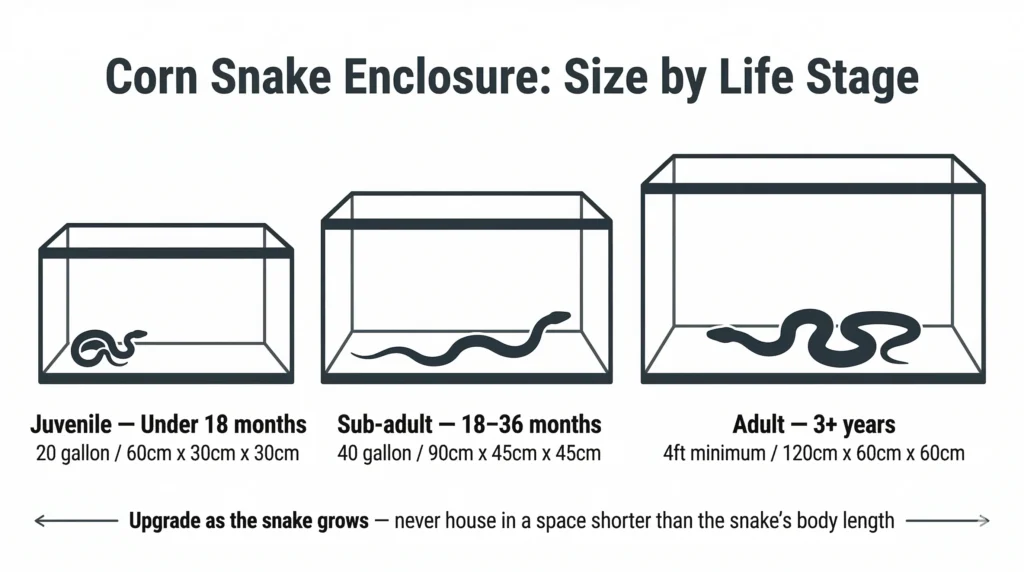
- Hatchling to juvenile (0–12 months): 10–20 gallon tank
- Sub-adult (12–24 months): 20–30 gallon
- Adult (24+ months, 4+ feet): 40-gallon breeder minimum; 4’x2’x2′ PVC enclosure is ideal
Corn snakes are terrestrial and semi-arboreal — they need both floor space and some climbing opportunities. A longer, lower enclosure is better than a tall one.
CRITICAL — Escape Prevention: Corn snakes are exceptional escape artists. They can compress their body to fit through gaps the width of their head and will methodically test every point of the lid. Use clips or locks on all screen tops. Check lid security before every feeding.
Temperature Gradient
Temperature Gradient
| Zone | Target Temperature | Method |
|---|---|---|
| Warm hide / warm end surface | 85–88°F (29–31°C) | Under-tank heater + thermostat |
| Warm side ambient | 80–85°F (27–29°C) | UTH radiating into air |
| Cool side ambient | 72–75°F (22–24°C) | Room temperature |
| Nighttime low | No lower than 65°F (18°C) | Ceramic heat emitter if needed |
Always use a thermostat with the UTH. A low-wattage ceramic heat emitter on a thermostat can supplement ambient warmth in cool rooms without disrupting the dark cycle.
Humidity
Normal: 40–60%. During shedding: increase to 65–75%.
- Provide a moist hide (plastic container + damp sphagnum moss) on the warm side at all times — especially important during shed
- Mist one side of the enclosure lightly during pre-shed (eyes turn blue, skin appears dull)
- Cypress mulch substrate retains moisture well and is safe for corn snakes
Substrate
Best options:
- Cypress mulch: excellent moisture retention, natural look, easy to replace
- Coconut fibre: good moisture retention, fine texture
- Aspen shavings: good for dry setups, inexpensive — but remove immediately if wet (mould risk)
- Bioactive mix: excellent for advanced keepers
Avoid: cedar and pine (toxic), sand, gravel, and paper towels for permanent setups.
Hides
- Minimum two hides: one on the warm end, one on the cool end
- Snug-fitting is key — the snake should be able to touch all sides; open space = insecurity
- Add a moist hide (damp sphagnum moss) as a third option year-round
Feeding
What to Feed
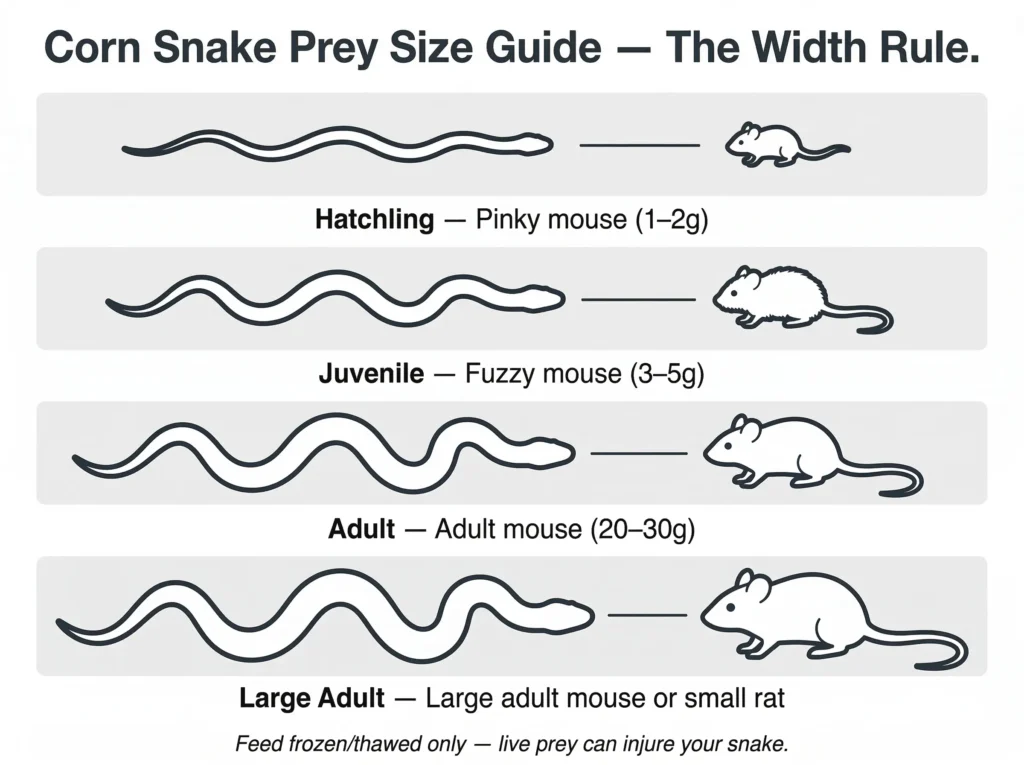
Corn snakes eat rodents exclusively. In captivity, always use frozen-thawed mice — never live prey. Live prey can seriously injure snakes (bites, scratches), and frozen-thawed rodents are safer, more humane, and more readily available.
Prey size: offer mice that are approximately the same diameter as the widest part of the snake’s body. A slight lump after swallowing is normal and expected — a prey item too large will be regurgitated.
Feeding Schedule
- Hatchlings (0–6 months): every 5–7 days, pinky mice
- Juveniles (6–12 months): every 7 days, fuzzy or hopper mice
- Sub-adults (12–24 months): every 7 days, adult mice
- Adults (24+ months): every 7–14 days, adult mice or small rats
How to Feed Safely
- Thaw the frozen mouse completely in warm water (not microwave — uneven heating)
- Warm to body temperature before offering (enhances smell, triggers feeding response)
- Use tongs — never hand-feed directly (trains the snake to strike at hands)
- Offer in the enclosure or in a separate feeding tub
- Leave the snake alone for 48 hours after feeding — handling too soon causes regurgitation
- Remove any uneaten prey after 30–60 minutes
Feeding Refusals
Corn snakes refuse food most commonly because of: shedding (always check for pre-shed signs), inadequate temperatures (warm end below 85°F prevents digestion), stress from recent handling or enclosure change, or breeding season (males in winter-spring). A corn snake that refuses food for more than 4–6 weeks without a clear reason warrants a vet check.
Shedding
Corn snakes shed every 4–8 weeks as juveniles, every 2–3 months as adults. Signs of an upcoming shed: eyes turn opaque blue-grey, skin dulls and appears slightly pink-hued, the snake becomes less active and may refuse food.
- Increase enclosure humidity to 65–75% when pre-shed signs appear
- Ensure the moist hide has fresh damp sphagnum moss
- Do not handle during shed — the snake is temporarily blind and more defensive
- A healthy shed comes off in one piece including the eye caps
Stuck shed treatment: 20–30 minute soak in shallow, warm water (30°C). After soaking, gently roll the retained skin off. For retained eye caps, see a reptile vet — attempting to remove them without experience risks permanent eye damage.
Handling
- Wait 2 weeks before first handling after bringing the snake home
- Wait 48 hours after feeding before any handling
- Do not handle during shedding
- Begin with 5–10 minute sessions and build to 20–30 minutes as the snake habituates
- Support the full body — do not dangle by the head or tail
- Move slowly and predictably
- A corn snake that is comfortable: moves fluidly, flicks tongue regularly, explores calmly
- A corn snake that is stressed: tightens into a coil, vibrates tail (mimicking a rattlesnake), hisses, or strikes
Most captive-bred corn snakes become very tolerant of regular handling within 4–6 weeks.
Health — Common Issues
Health Issues
| Condition | Signs | Cause | Action |
|---|---|---|---|
| Stuck shed | Retained skin in patches or over eyes | Low humidity; absent moist hide | Warm soak; correct humidity; moist hide |
| Respiratory infection (RI) | Wheezing, mucus from mouth/nose, lethargy | Low temperatures + incorrect humidity | Reptile vet; antibiotic treatment |
| Mites | Tiny black specks on skin or in water bowl; rubbing on décor | Exposure from feeders or new enclosure items | Reptile vet; full enclosure disinfection; treat with prescription mite treatment |
| Regurgitation | Vomiting 24–72 hours after feeding | Handled too soon; prey too large; cold enclosure | Do not feed for 2 weeks; identify and fix the cause; vet if recurring |
| Scale rot | Discoloured, blistered, or soft scales on belly | Substrate too wet; humidity too high | Vet assessment; dry substrate; correct humidity |
| Anorexia | Refusal to eat for 4+ weeks | Many causes (see Feeding Refusals above) | Vet if no improvement after basic checks |
Frequently Asked Questions
How big do corn snakes get?
Most adults reach 4–5 feet (120–150 cm). Females tend to be slightly longer and heavier than males. Some individuals reach 6 feet, though this is uncommon. They reach adult size by approximately 3 years of age.
Can corn snakes be housed together?
No — corn snakes are solitary and should never be cohabited. They will compete for hides, stress each other, and may attempt to eat each other during feeding. Always one snake per enclosure.
Do corn snakes need a heat lamp?
They do not require a heat lamp specifically, but they do need a warm end of 85–88°F. This is most efficiently achieved with an under-tank heater connected to a thermostat, supplemented by a ceramic heat emitter in colder rooms. Heat lamps can be used but require careful thermostat control to avoid overheating.
Why is my corn snake always in its hide?
This is normal behaviour — corn snakes are secretive and spend most of the day hidden. They are most active at dusk and dawn. If the snake never comes out even at night, check temperatures (too hot or too cold drives them to hide) and stress levels (recent enclosure change, too much handling, insecure lid).
Sources
- Reptiles Magazine — Corn Snake Care: reptilesmagazine.com
- American Association of Reptile Keepers: usark.org
- Merck Veterinary Manual — Colubrid Snake Husbandry
- North American Field Herping Association: nafha.org