

If your dog won’t stop barking, the most important thing to understand is that barking is never random — every bark has a function. Dogs bark because it works. It gets attention, it warns intruders off, it relieves anxiety, it communicates. Your job is not to silence the dog but to identify which of the 23 functions the barking is serving — because the solution depends entirely on the cause. This guide ranks all 23 from most to least likely so you can start at the top and work your way down.
The most common causes of excessive barking are territorial alerting, attention-seeking, boredom, and separation anxiety. Barking that starts suddenly in a previously quiet dog, or in a senior dog, often has a medical cause and warrants a vet visit. Never punish barking — it increases anxiety and worsens the behaviour in most cases.
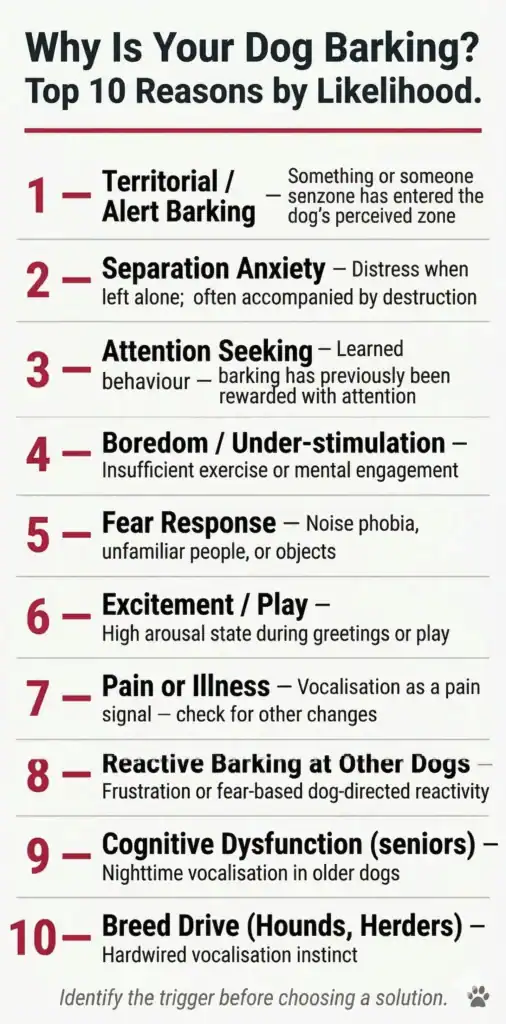
THE 23 REASONS AT A GLANCE
Behavioural (Most Common):
1. Territorial / protective barking
2. Alarm barking (sounds, movement)
3. Attention-seeking barking
4. Boredom and under-stimulation
5. Separation anxiety
6. Greeting behaviour
7. Fear-based barking
8. Frustration / barrier barking
9. Reactive barking at other dogs
10. Play barking
Breed and Instinct-Driven:
11. Breed-specific vocalisation
12. Guard dog instinct
13. Herding instinct barking
14. Hunting / scent hound vocalisation
Environmental Triggers:
15. Response to other dogs barking
16. Weather, thunder, or fireworks phobia
17. Over-arousal and stimulation overload
18. Loneliness in a multi-dog household
19. Learned / reinforced barking
Medical Causes (Rule Out If Sudden Onset):
20. Pain or physical discomfort
21. Cognitive dysfunction syndrome (doggy dementia)
22. Hearing or vision loss
23. Thyroid or hormonal imbalance
The 23 Reasons Explained
BEHAVIOURAL CAUSES
1. Territorial / Protective Barking
The most common type. The dog perceives its territory (home, garden, car) as something to defend and barks at anyone or anything that approaches it. The barking typically stops once the perceived threat leaves — which reinforces the behaviour because the dog learns that barking makes things go away.
Triggers: visitors at the door, people walking past the window, delivery drivers, cars on the driveway.
Solution: management first (block the sightline with frosted window film or keep the dog out of the front room during peak delivery hours), then systematic desensitisation by gradually exposing the dog to the trigger at sub-threshold distance and rewarding calm behaviour.
2. Alarm Barking
Similar to territorial barking but triggered by sounds rather than visible intruders — a car door, a bin being knocked over, a phone notification. The dog has an extremely sensitive alert threshold.
Solution: a white noise machine near the dog’s resting area reduces auditory triggers significantly. Teaching a “quiet” cue paired with an incompatible behaviour (going to a mat) gives you a reliable tool.
3. Attention-Seeking Barking
The dog has learned that barking produces a response — eye contact, a verbal reaction, food, or physical attention. Even a “no!” is a reward in this context because it means the human looked up.
Signs: barking directed at you, stops when you respond, starts again if you stop paying attention, often accompanied by pawing or nudging.
Solution: complete and total extinction — zero response to the bark, including no eye contact. The moment the dog is quiet, even for one second, reward heavily. This gets worse before it gets better (extinction burst) before it improves. Consistency is non-negotiable.
4. Boredom and Under-Stimulation
A dog that does not have enough physical exercise, mental enrichment, or social interaction will bark to self-stimulate. This is especially common in high-drive working breeds kept in low-activity homes.
Signs: barking with no specific trigger, often rhythmic and monotonous, occurs throughout the day, accompanied by other destructive behaviours (chewing, digging).
Solution: increase exercise (breed-appropriate quantity), add structured enrichment (snuffle mats, puzzle feeders, training sessions), and consider a dog walker or daycare for dogs alone during the day.
5. Separation Anxiety
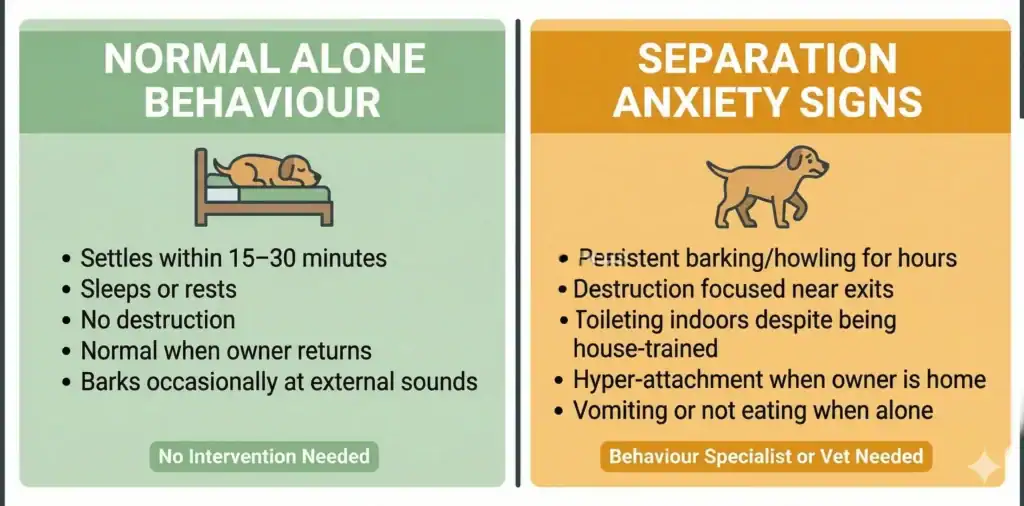
The dog is distressed when left alone and barks, howls, or whines continuously. This is a genuine anxiety disorder, not a behaviour problem, and requires a systematic treatment protocol rather than obedience training.
Signs: barking begins within minutes of the owner leaving and continues until they return, often with destructive behaviour, house soiling, and attempts to escape. The dog may also be hyper-attached when the owner is home.
Solution: a full separation anxiety protocol — starting with absences of seconds and gradually building duration. This takes weeks to months. Consider working with a certified separation anxiety trainer (CSAT) or ask your vet about short-term anti-anxiety medication to facilitate the training process.
6. Greeting Behaviour
Excited, high-pitched barking when people arrive — usually the owner returning home or visitors entering. The dog is expressing joy, not aggression.
Solution: remove the drama from arrivals. Ignore the dog completely until all four paws are on the floor and the dog is calm. Reward calm greetings. Teach a greeting ritual — going to fetch a toy is an incompatible behaviour with barking.
7. Fear-Based Barking
Barking at a stimulus the dog finds frightening — strangers, certain types of people, uniforms, hats, equipment. The bark is a “go away” communication, not aggression, though it can escalate to snapping if the trigger continues approaching.
Signs: barking combined with retreating, tucked tail, flattened ears, whale eye (whites of the eyes visible).
Solution: counter-conditioning — pairing the scary stimulus with something the dog loves (high-value treats) at a distance where the dog notices but is not over threshold. Never force the dog to approach what it fears.
8. Frustration / Barrier Barking
The dog can see or hear something it wants to reach but cannot — another dog on the other side of a fence, a squirrel it cannot chase, a cat through a window. Frustration drives a frantic, often continuous bark.
Solution: management (block the sightline or remove access to the barrier), combined with training a calm settle behaviour in the presence of the trigger.
9. Reactive Barking at Other Dogs
The dog lunges and barks at other dogs on the lead. Often misread as aggression — it is more frequently frustration (the dog wants to interact but cannot) or fear (the dog wants distance). Both look identical from the outside.
Solution: this requires systematic behaviour modification with a qualified positive reinforcement trainer or behaviourist. Do not correct or punish reactive barking — it suppresses the warning signal without addressing the emotion and can accelerate escalation to biting.
10. Play Barking
Sharp, high-pitched, intermittent barks during active play. This is normal communication.
Signs: occurs only during play, accompanied by loose, bouncy body language, play bows, wagging tail.
Action: no intervention needed unless it escalates into frenzy or aggression. A short timeout (remove attention for 30 seconds) if play becomes too aroused.
BREED AND INSTINCT-DRIVEN BARKING
11. Breed-Specific Vocalisation
Some breeds are genetically wired to vocalise far more than others. Attempting to train a Siberian Husky into silence is working against thousands of years of selective breeding. Understanding and accommodating the breed’s vocal nature — rather than fighting it — produces better outcomes. For a full guide on managing Husky-specific behaviours, see our article on Husky Care 101: Why Generic Dog Training Fails This Breed.
High-vocalisation breeds: Siberian Huskies, Beagles, Basset Hounds, Dachshunds, Miniature Schnauzers, Chihuahuas, Yorkshire Terriers, German Shepherds.
Solution: channelling the behaviour — teaching a “speak” cue so the dog has a conditioned outlet, and “quiet” as its paired opposite.
12. Guard Dog Instinct
Breeds selectively bred for protection work have a lower threshold for alert barking and a stronger drive to warn — it is literally what they were designed to do.
Breeds: German Shepherds, Dobermanns, Rottweilers, Belgian Malinois, Giant Schnauzers. For breed-specific management strategies, see our guide on German Shepherd Guide: Working Lines vs Show Lines.
Solution: structured training that gives the dog a clear protocol — bark once to alert, then disengage on cue. This channels the instinct rather than suppressing it entirely.
13. Herding Instinct Barking
Herding breeds bark to move livestock — and in domestic settings, they redirect this at children, other pets, bicycles, or moving objects. The bark is sharp and authoritative.
Breeds: Border Collies, Australian Shepherds, Shelties, Corgis.
Solution: herding breeds require very high levels of mental and physical activity. Herding the dog (so to speak) into structured sports — agility, obedience, herding trials — redirects the drive appropriately.
14. Hunting / Scent Hound Vocalisation
Scent hounds bay — a long, mournful, carrying vocalisation — when they pick up an interesting scent. It is a deeply instinctive communication behaviour bred in over centuries.
Breeds: Beagles, Bloodhounds, Coonhounds, Basset Hounds.
Solution: scent work activities (nose work classes, tracking) provide a legal, controlled outlet for the instinct. Management of outdoor access prevents uncontrolled baying in the garden.
ENVIRONMENTAL TRIGGERS
15. Response to Other Dogs Barking
Dogs are social communicators. One barking dog in a neighbourhood can trigger a chain reaction. Your dog may not even know why it is barking — it is simply responding to the social signal.
Solution: white noise indoors, management of outdoor access during peak bark times (early morning, late evening).
16. Weather, Thunder, or Fireworks Phobia
Noise phobia is a true anxiety disorder with a physiological component — the dog’s body floods with stress hormones during the event. Barking is part of the fear response.
Solution: a pressure wrap (Thundershirt), a white noise machine, Adaptil (DAP) diffuser, desensitisation recordings played at very low volume during calm periods to reduce sensitivity. For severe cases, ask your vet about situational medication (trazodone, gabapentin, alprazolam) before the event.
17. Over-Arousal and Stimulation Overload
A dog that has been playing, excited, or stimulated for too long tips into a state of over-arousal where it cannot settle — and barks as a symptom of the inability to calm down.
Signs: frantic, out-of-context barking during or after high-energy activity, the dog seems unable to stop itself.
Solution: structured decompression — a long, slow sniff walk rather than a high-energy run. Sniffing activates the parasympathetic (calming) nervous system. Follow high-arousal activities with low-arousal ones.
18. Loneliness in a Multi-Dog Household
A dog that is socially isolated from its companions — separated for any reason — may bark continuously out of social distress. This is distinct from separation anxiety and is about dog-to-dog social bonding.
Solution: maintain dog social groups during the day wherever possible. If one dog needs rest or isolation (post-surgery), white noise and a worn item of the owner’s clothing reduce distress.
19. Learned / Reinforced Barking
Anything the dog has been inadvertently rewarded for — a bark that resulted in food, play, attention, or a walk — becomes a conditioned behaviour. This includes owners who give treats to “distract” a barking dog, which teaches the dog that barking produces treats.
Solution: extinction combined with rewarding any alternative, incompatible behaviour. Identify what the barking has previously produced and remove that reward entirely.
MEDICAL CAUSES
20. Pain or Physical Discomfort
A dog in pain — dental disease, arthritis, abdominal pain, ear infection — may bark or whine, especially when moving, being touched, or trying to settle. If barking onset was sudden with no behavioural trigger, pain is one of the first things to rule out.
Signs: barking when getting up or lying down, when a specific area is touched, at night when the dog cannot get comfortable.
Action: vet appointment. Pain management changes the behaviour immediately once the source is treated.
21. Cognitive Dysfunction Syndrome (Canine Dementia)
Senior dogs with cognitive decline often bark at night — disoriented, confused, and unable to process their environment normally. This is one of the most distressing and misunderstood forms of barking.
Signs: night-time barking in a dog over 9–10 years, staring at walls, getting lost in familiar spaces, changed sleep-wake cycle.
Action: vet appointment. Selegiline (Anipryl) is an approved medication for canine CDS. Environmental modifications (night lights, predictable routine) help significantly.
22. Hearing or Vision Loss
A dog that can no longer hear or see well may bark at stimuli it cannot properly process — sounds it cannot locate, shapes it cannot identify. This is confusion and mild anxiety, not aggression.
Signs: onset in a senior dog, startling easily when approached from the blind side or from behind, seeming confused or disoriented.
Action: vet assessment and ophthalmology/audiology referral. Management includes approaching the dog within its visual field, using vibration cues (touch or foot stomping on the floor), and keeping the environment consistent.
23. Thyroid or Hormonal Imbalance
Hypothyroidism (low thyroid function) can cause anxiety and behavioural changes including increased vocalisation in some dogs. This is less common but worth investigating in a dog with sudden, unexplained behavioural changes alongside weight gain, lethargy, and coat changes.
Signs: barking changes alongside weight gain, low energy, skin and coat changes, seeking warmth.
Action: vet blood panel including thyroid levels. Hypothyroidism is easily managed with daily levothyroxine and behavioural symptoms often resolve with treatment.
The Solution Framework — Match the Cause to the Fix
| Barking Type | Core Approach | Avoid |
|---|---|---|
| Territorial / alarm | Block sightlines + desensitisation | Punishing the bark |
| Attention-seeking | Complete extinction + reward calm | Any attention during the bark |
| Boredom | Increase exercise + enrichment | Corrective devices |
| Separation anxiety | Graduated absence protocol | Punishment; flooding |
| Fear-based | Counter-conditioning at sub-threshold | Forcing approach to trigger |
| Breed vocalisation | Channel via sport + teach speak/quiet cue | Suppression training |
| Medical | Treat the underlying condition | Behaviour training without vet check |
What Never to Do When a Dog Won’t Stop Barking
- Never use a shock collar, citronella collar, or ultrasonic device as a first response — these suppress the symptom without addressing the cause and increase anxiety in most dogs
- Never shout “quiet” repeatedly — the dog interprets this as you barking along and may escalate
- Never physically punish a barking dog — adds fear to an already aroused state
- Never reward a barking dog with food, play, or attention to “calm them down” — it directly reinforces the behaviour
Frequently Asked Questions
How long does it take to stop a dog from barking?
It depends entirely on the cause and consistency of the approach. Attention-seeking barking trained with clean extinction can improve within a week. Separation anxiety treated with a full protocol takes 2–6 months. Reactive barking with a certified behaviourist takes 3–12 months of consistent work. There are no shortcuts.
Do anti-bark collars work?
Citronella and ultrasonic collars reduce barking in some dogs temporarily but do not address the cause, and the effect fades as the dog habituates. Shock collars carry serious risks of increased aggression and anxiety and are banned for sale and use in several countries. Neither is recommended as a long-term or first-line solution.
Why does my dog bark at night?
Night-time barking in younger dogs is usually attention-seeking or insufficient daytime exercise. In senior dogs, it is often the first sign of cognitive dysfunction syndrome (canine dementia). A vet assessment is recommended for any dog that begins night barking suddenly after years of sleeping quietly.
Can barking be a sign of illness?
Yes — sudden onset barking in a previously quiet dog, or barking specifically when the dog is moving or being touched, warrants a vet visit to rule out pain, cognitive dysfunction, hearing loss, or a hormonal issue. Behaviour changes in dogs are medical until proven otherwise.
Sources
- American Veterinary Society of Animal Behaviour — Position Statement on Punishment: avsab.org
- American Kennel Club — Understanding Dog Barking: akc.org
- Merck Veterinary Manual — Behavioural Problems in Dogs
- Companion Animal Psychology — Separation Anxiety in Dogs: companionanimalpsychology.com