
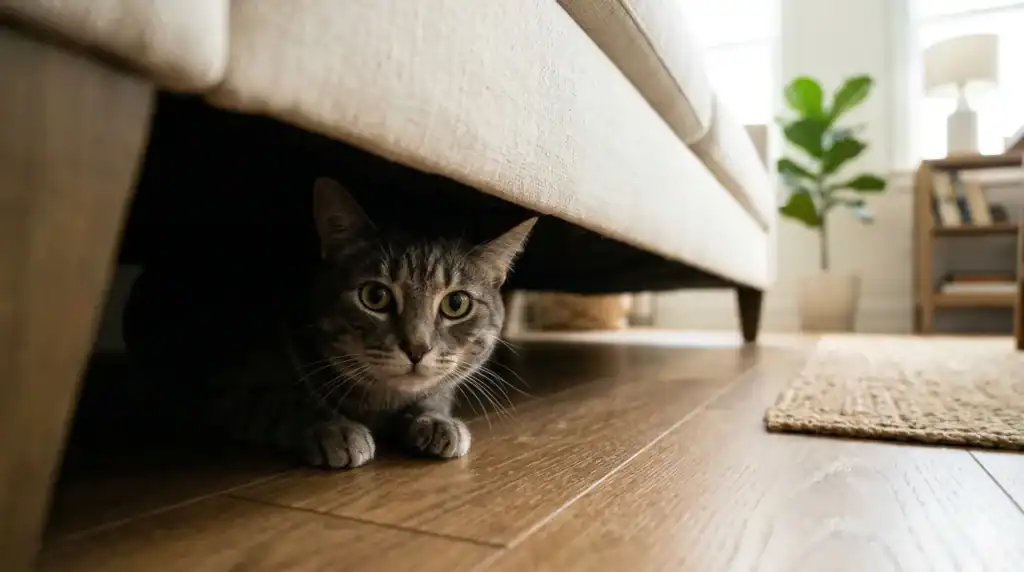
Cats hiding is one of those behaviours that sits in a frustrating grey zone — it can be completely normal or a sign of serious illness, and the two can look identical from the outside. A cat that retreats under the bed after guests leave is just decompressing. A cat that has been under the bed for two days without eating is telling you something is very wrong. The difference lies in duration, what else is changing, and whether the cat comes out voluntarily. This guide covers all 13 reasons, from mildest to most urgent.
Cats hide naturally when stressed, overstimulated, or recovering from an experience. This is normal if the cat comes out to eat, drink, and use the litter box and returns to normal within 24–48 hours. Hiding that lasts more than 48 hours, or is accompanied by refusal to eat, vomiting, or laboured breathing, is a medical concern requiring veterinary attention.
THE 13 REASONS AT A GLANCE
Normal or Behavioural:
1. Natural feline instinct (all cats need alone time)
2. Overstimulation or sensory overload
3. Stress from environmental change
4. New pet or new person in the home
5. Visitors or loud events (parties, fireworks, construction)
6. Post-surgery or medication recovery
7. Pregnancy / pre-birth nesting
Medical Causes — Needs Veterinary Assessment:
8. Pain (any source)
9. Upper respiratory infection or fever
10. Kidney disease (CKD)
11. Hypertrophic cardiomyopathy (HCM)
12. Feline cognitive dysfunction (dementia)
13. End-of-life behaviour
Why Cats Hide — The Biology Behind It
Hiding is a survival strategy embedded in feline biology. Cats are both predator and prey in the wild — they hide to stalk prey and hide when sick or vulnerable to avoid becoming prey themselves. Domestic cats never lost this instinct. A cat that feels unwell, frightened, or overwhelmed does exactly what its ancestors did: it finds a small, enclosed, dark space and waits.
This is why hiding is such a powerful diagnostic clue. When a cat hides more than usual, something in its world has changed — either emotionally or physically.
The 13 Reasons Explained
NORMAL OR BEHAVIOURAL CAUSES
1. Natural Feline Instinct
Every cat, regardless of personality, needs solo downtime. Introverted cats may spend several hours a day in a preferred hiding spot — a wardrobe, under a bed, inside a box — and emerge on their own terms. This is completely normal, particularly in multi-person or multi-pet households.
Signs this is normal: the cat comes out to eat, drink, and use the litter box without being coaxed, returns to normal interaction within hours, has done this consistently throughout its life.
Action: provide at least one designated safe hiding space per cat in the home. A cat that has its own retreat is actually less anxious than one that must improvise.
2. Overstimulation or Sensory Overload
Petting sessions that go on too long, play that becomes too intense, or simply too much household noise can push a cat past its threshold. It withdraws to reset.
Signs: hiding immediately following play or petting, emerges calmly after 30–60 minutes, no other symptoms.
Action: learn your cat’s signals for “I’ve had enough” — tail flicking, skin rippling, dilated pupils, ears rotating back. Stop before these escalate. Overstimulation hiding resolves quickly on its own.
3. Stress from Environmental Change
Moving house, rearranged furniture, a new baby, a change in the owner’s schedule, or even a new brand of litter can be significant enough stressors to cause days of increased hiding in a sensitive cat.
Signs: hiding began directly after a specific change, cat is alert and watching from the hiding spot (not hunched or withdrawn), resumes normal behaviour gradually over 2–5 days.
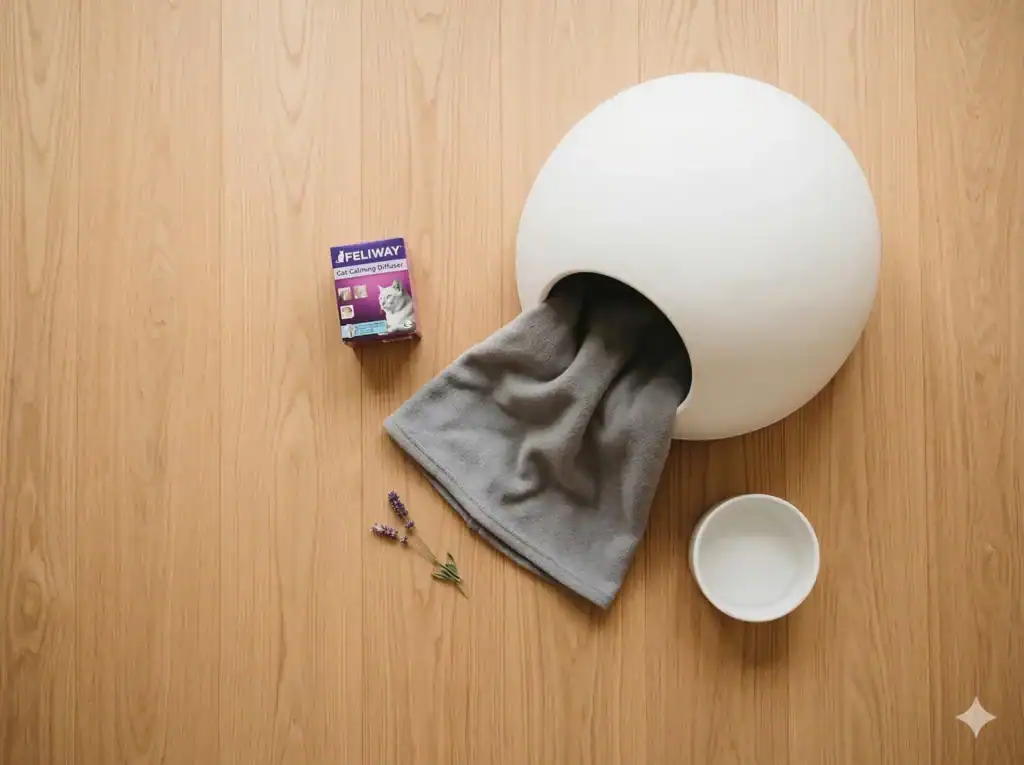
Action: minimise unnecessary changes during stressful periods. Use Feliway Classic diffuser in the room where the cat hides most — synthetic feline facial pheromones significantly reduce stress-hiding duration in most cats.
4. New Pet or New Person in the Home
A new dog, a new cat, or a new person moving in disrupts the cat’s established territory and social structure. Hiding is the cat’s way of monitoring the situation from a safe distance before deciding whether to engage.
Signs: hiding that began specifically when the new arrival appeared, the cat watches from the hiding spot rather than sleeping deeply, comes out when the new arrival is not present.
Action: do not force interaction. Create vertical space (cat trees, shelves) so the cat can observe from height — this significantly reduces threat perception. Patience is the most effective tool here. Most cats establish a functional relationship with a new resident within 2–8 weeks. For more on managing multiple cats, see our guide on Cat Vomiting: Hairballs vs Food vs Illness — stress is a common trigger for vomiting in newly disrupted cats.
5. Visitors or Loud Events
Fireworks, parties, thunderstorms, construction, and the presence of unfamiliar people cause acute stress in most cats. Hiding during these events is appropriate and protective.
Signs: hiding only during or immediately after the stressor, full return to normal within hours of the event ending.
Action: for recurring events (fireworks, storms), consider Feliway Optimum, a calming supplement (Zylkene), or ask your vet about short-term anti-anxiety medication for particularly fearful cats.
6. Post-Surgery or Medication Recovery
Anaesthetic and surgical pain both cause cats to withdraw and hide. This is expected for 24–48 hours post-procedure.
Signs: hiding began directly after a vet visit or procedure, the cat eats small amounts when offered food near the hiding spot, gradually re-emerges over 1–3 days.
Action: create a quiet, warm recovery space. Place food, water, and a litter box close to where the cat is resting. Follow your vet’s post-operative guidelines for activity restriction and pain management.
7. Pregnancy / Pre-Birth Nesting
An unspayed pregnant cat will begin seeking out enclosed, dark, private spaces 12–48 hours before giving birth. This is nesting behaviour.
Signs: cat is visibly pregnant, hiding increases in the days before expected birth, cat is restless and moving between spots before settling, milk may be visible.
Action: provide a dedicated nesting box in a quiet room — a large cardboard box lined with clean towels. Keep other pets and household traffic away from the area.
MEDICAL CAUSES — NEEDS VETERINARY ASSESSMENT
8. Pain
Any source of pain — dental disease, arthritis, an internal injury, urinary blockage, or abdominal pain — causes a cat to hide. Pain-hiding is one of the strongest evolutionary behaviours in cats and one of the most dangerous, because it masks the severity of the condition.
Signs: hiding that appeared without a clear trigger, cat flinches or reacts when touched in a specific area, reluctance to jump, change in gait, not eating. If your cat is also refusing food, see our guide on Cat Not Eating? 18 Reasons Ranked by Urgency.
Action: vet appointment within 24 hours. Do not wait for the cat to come around — pain-hiding is a red flag.
9. Upper Respiratory Infection or Fever
A sick cat with a URI or fever feels profoundly unwell and hides instinctively. The cat may be visibly congested, sneezing, or squinting but makes no sound.
Signs: hiding alongside sneezing, runny nose, watery eyes, open-mouth breathing, or elevated temperature (normal cat temperature is 38–39°C / 100.4–102.5°F).
Action: vet within 24 hours. URIs require antiviral or antibiotic treatment and sometimes appetite stimulants, as a congested cat cannot smell food and stops eating.
10. Chronic Kidney Disease (CKD)
Kidney disease causes toxin buildup, nausea, and profound malaise. Hiding is one of the earliest signs — often appearing before the owner notices weight loss or increased thirst.
Signs: increased hiding in a cat over 8, accompanied over weeks by gradual weight loss, increased water intake, vomiting (especially yellow bile in the morning), and dull coat. For the full picture of CKD symptoms, see our guide on Cat Not Eating? 18 Reasons Ranked by Urgency.
Action: vet appointment and blood/urine panel. CKD is managed, not cured — but early intervention significantly extends quality of life.
11. Hypertrophic Cardiomyopathy (HCM)
The most common heart disease in cats. The heart muscle thickens, reducing its ability to pump blood efficiently. Cats with HCM hide because they feel breathless and weak — but many show no other visible signs until the disease is advanced.
Breeds most at risk: Maine Coons, Ragdolls, British Shorthairs, Persians, and Sphynx cats — though any cat can develop HCM.
Signs: hiding in a previously social cat, open-mouth breathing or rapid breathing at rest (more than 30 breaths per minute when sleeping), reluctance to move, blue-tinged gums.
Action: emergency vet if breathing is laboured. Routine vet appointment if hiding is the only sign. HCM is diagnosed by echocardiogram (ultrasound of the heart).
12. Feline Cognitive Dysfunction (Dementia)
The feline equivalent of Alzheimer’s disease. Cats over 15 are most commonly affected. Disorientation and confusion cause the cat to hide in unusual places — inside cupboards, behind appliances, in corners — often vocalising at night.
Signs: hiding in places the cat never used before, getting stuck or confused in familiar rooms, vocalising at night for no apparent reason, forgetting the location of the litter box, increased sleep.
Action: vet assessment to rule out other causes (hyperthyroidism, hypertension, pain). Management includes environmental enrichment, night lights, predictable routines, and in some cases, selegiline medication.
13. End-of-Life Behaviour
Cats instinctively withdraw and isolate as they approach the end of life. This is a deeply ingrained survival behaviour — in the wild, a dying animal that isolates itself avoids drawing predators to the group.
Signs: very senior or terminally ill cat, hiding in unusual or remote spots, no longer interested in food, water, or interaction, increasingly quiet and still, weight loss and physical decline over weeks.
Action: contact your vet for guidance on comfort care, pain management, and quality-of-life assessment. The Feline Quality of Life Scale (developed by Dr. Alice Villalobos) is a widely used framework for making end-of-life decisions with compassion.
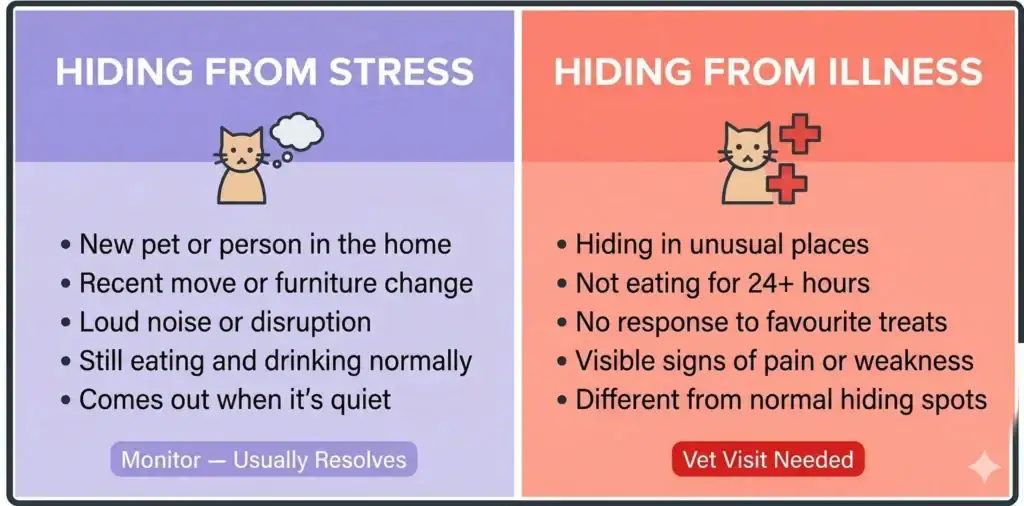
How to Tell Normal Hiding from Medical Hiding
| Sign | Normal Hiding | Medical Concern |
|---|---|---|
| Duration | Hours to 1–2 days | More than 48 hours |
| Eating and drinking | Yes, voluntarily | Reduced or stopped |
| Litter box use | Normal | Changed frequency or avoided |
| Comes out when coaxed | Yes, briefly | Reluctant or unresponsive |
| Body position in hiding spot | Alert, watching, relaxed | Hunched, eyes closed, withdrawn |
| Trigger | Clear event (visitor, noise, change) | No identifiable trigger |
| Other symptoms | None | Vomiting, sneezing, weight loss, laboured breathing |
What to Do If Your Cat Is Hiding and You Are Worried
- Note when the hiding started — was there an identifiable trigger?
- Offer food and water near the hiding spot without forcing the cat out
- Count resting breathing rate — more than 30 breaths per minute = vet same day
- Check for other symptoms: vomiting, sneezing, weight loss, gum colour
- If no trigger and hiding exceeds 48 hours → vet appointment
- If breathing is laboured or gums are pale/blue → emergency vet immediately
- Never drag the cat out — forced removal increases stress and may worsen a medical condition
Frequently Asked Questions
How long is it normal for a cat to hide?
Up to 24–48 hours after a clear stressor (visitors, fireworks, a vet visit) is within the range of normal. Hiding with no identifiable trigger, or hiding that extends beyond 48 hours, should prompt a vet assessment.
Should I leave a hiding cat alone?
Yes, for behavioural hiding — forcing a stressed cat out of its safe space prolongs the recovery. Leave fresh food, water, and a clean litter box within reach. Check in calmly without making direct eye contact (perceived as threatening by cats). Let the cat re-emerge on its own timeline.
Why does my cat hide after a vet visit?
The car journey, the clinic smells (other animals, cleaning products, fear pheromones), and the handling combine to create a highly stressful experience. Most cats hide for several hours to a day after a vet visit and return to normal on their own. Feliway spray on the carrier before the trip can reduce travel stress significantly.
My cat is hiding and not eating — how urgent is this?
Very urgent. A cat that is both hiding and refusing food for more than 24 hours needs a vet appointment same day. Cats cannot safely go without food — hepatic lipidosis (fatty liver disease) can develop within 48 hours and is life-threatening.
Sources
- Cornell University College of Veterinary Medicine — Feline Behaviour: vet.cornell.edu
- American Association of Feline Practitioners — Feline HCM: catvets.com
- Merck Veterinary Manual — Cognitive Dysfunction in Cats
- International Cat Care — Understanding Hiding Behaviour: icatcare.org