
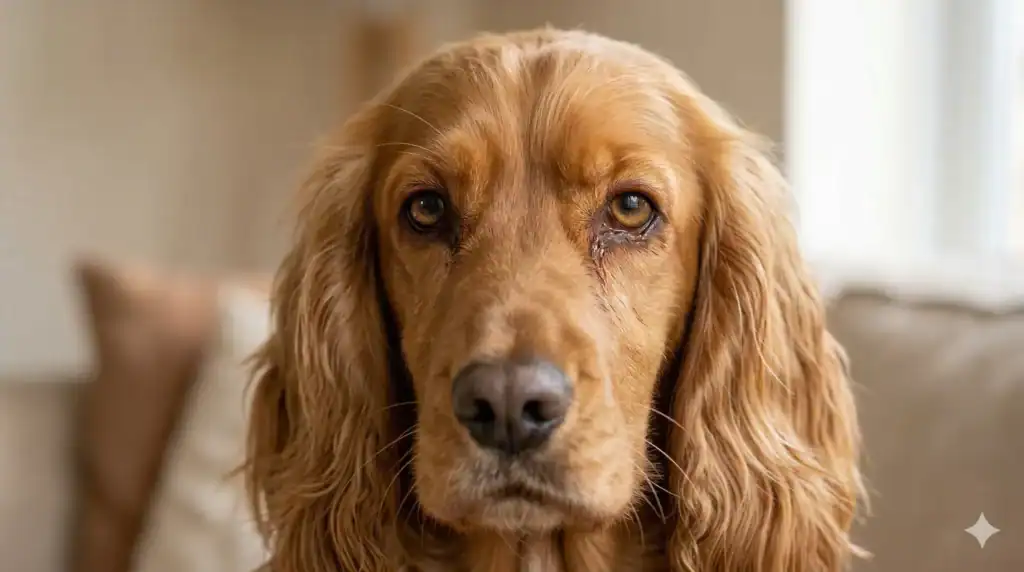
Dog eye discharge is one of those symptoms that is easy to dismiss as “just sleep in the eyes” — until it isn’t. The colour, consistency, and which eye is affected are all diagnostic clues that vets use to narrow down the cause within seconds. A watery clear discharge is almost always harmless. A thick green or yellow discharge signals infection. A sudden red or bloody discharge needs same-day veterinary care. This guide gives you the colour-coded system vets use so you can make that call confidently.
Clear or watery discharge is usually normal or allergy-related. White, grey, or sticky mucus points to dry eye (KCS). Yellow or green discharge indicates bacterial infection and needs a vet. Brown or rust-coloured staining under the eyes is tear staining from chronic overflow. Any red, bloody, or sudden discharge with squinting needs same-day vet care.
THE 12 CAUSES AT A GLANCE
Normal or Minor:
1. Normal overnight crust (rheum)
2. Epiphora (overflow tearing / tear staining)
3. Environmental allergies
4. Mild blocked tear duct
Infection or Inflammation:
5. Bacterial conjunctivitis
6. Viral conjunctivitis
7. Dry eye (Keratoconjunctivitis Sicca / KCS)
Structural Issues:
8. Entropion (eyelid rolling inward)
9. Cherry eye (prolapsed third eyelid gland)
10. Foreign body (grass seed, dust, debris)
Urgent / Emergency:
11. Corneal ulcer
12. Glaucoma
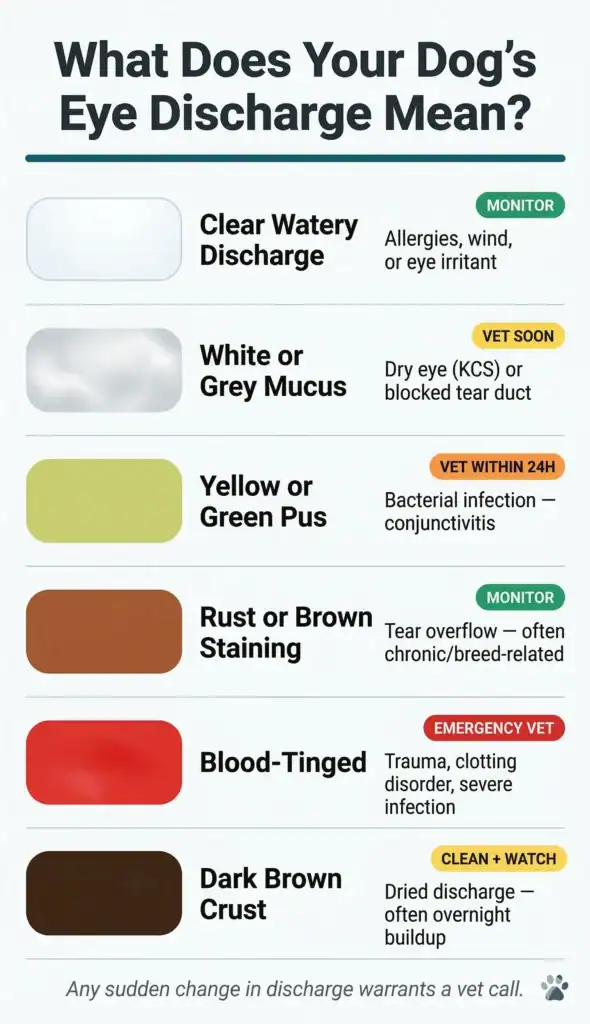
The Dog Eye Discharge Colour Chart
| Discharge Colour & Texture | Most Likely Cause | Action |
|---|---|---|
| Clear and watery, one or both eyes | Allergies, mild irritation, or normal | Monitor |
| Clear and watery, sudden onset one eye | Foreign body or early corneal issue | Check the eye, vet if persists 24h |
| White or grey, thick and sticky | Dry eye (KCS) | Vet within 48 hours |
| Brown or rust-coloured staining below eye | Epiphora (tear overflow), blocked duct | Vet appointment for persistent cases |
| Yellow or yellow-green, one or both eyes | Bacterial conjunctivitis | Vet within 24 hours |
| Green, thick and heavy | Serious bacterial infection | Vet same day |
| Cloudy or blue-grey haze over eye | Corneal ulcer or anterior uveitis | Vet same day |
| Red or bloodshot whites with discharge | Conjunctivitis, glaucoma, or trauma | Vet same day |
| Bloody discharge | Trauma, rupture, severe ulcer | Emergency vet immediately |
The 12 Causes Explained
NORMAL OR MINOR
1. Normal Overnight Crust (Rheum)
A small amount of crusty, brownish-black discharge in the inner corner of the eye after sleep is completely normal in all dogs. This is dried mucus, oil, and dead cells — the eye’s natural cleaning process.
Normal signs: small crust in the inner corner only, easily wiped away, both eyes clear during the day, no redness or squinting.
Action: wipe gently with a damp cotton pad during your regular grooming routine. No vet visit needed unless it increases in volume or changes colour.
2. Epiphora (Overflow Tearing / Tear Staining)
Epiphora means excessive tearing that overflows onto the face instead of draining through the tear duct. The constant moisture oxidises and creates the reddish-brown staining under the eyes — most visible in light-coloured dogs.
Breeds most affected: Maltese, Bichon Frise, Shih Tzu, Poodles, French Bulldogs. Flat-faced (brachycephalic) breeds are especially prone due to shallow eye sockets. For a full breakdown of brachycephalic eye issues, see our guide on French Bulldog Health: The ‘Big 7’ Respiratory & Joint Issues.
Signs to watch: rust or brown staining on the fur below the eyes, wet face, skin irritation or odour in the stained area, dog rubbing its face.
Action: keep the area clean and dry. Vet assessment to rule out blocked tear duct, entropion, or irritation as the underlying trigger. Prescription eye drops or a minor procedure to open the tear duct may be recommended.
3. Environmental Allergies
Pollen, dust mites, mould, and grass cause the same watery, itchy eye response in dogs that hay fever causes in humans. This is often accompanied by skin itching, making the two symptoms linked. If your dog is also scratching constantly, see our guide on Dog Scratching But No Fleas? 19 Causes + 7 Vetted Home Remedies.
Signs to watch: clear, watery discharge from both eyes, seasonal pattern, concurrent scratching and licking of paws, rubbing face on carpet or furniture.
Action: vet assessment and allergy management. Antihistamines (cetirizine or loratadine — NOT diphenhydramine for dogs with allergies), medicated eye drops, or prescription allergy treatment (Cytopoint, Apoquel).
4. Mild Blocked Tear Duct (Nasolacrimal Occlusion)
The tear duct that drains tears from the eye into the nose becomes blocked, causing tears to overflow onto the face. Can be caused by debris, inflammation, or a structural narrowing.
Signs to watch: overflow tearing from one eye, no infection signs (no yellow/green), the eye itself looks clear and comfortable.
Action: vet can flush the duct under sedation — straightforward procedure with good success rate.
INFECTION OR INFLAMMATION
5. Bacterial Conjunctivitis
Inflammation and infection of the conjunctiva (the lining of the eye and inner eyelids). Produces yellow or green discharge and makes the white of the eye look red. Often affects one eye initially before spreading to both.
Signs to watch: yellow or green discharge, red or pink whites of the eye, squinting or pawing at the eye, crusting that seals the eye shut overnight.
Action: vet within 24 hours. Prescription antibiotic eye drops (typically chloramphenicol or neomycin-based) clear most cases within 5–7 days.
6. Viral Conjunctivitis
Caused by a viral infection, often distemper or herpesvirus. Discharge is typically clear and watery rather than purulent, but the eye is visibly red and irritated.
Signs to watch: clear watery discharge in a puppy or unvaccinated dog, redness, light sensitivity, associated upper respiratory signs (sneezing, nasal discharge).
Action: vet assessment to rule out distemper. Supportive treatment and antiviral eye drops where appropriate. Vaccination is the most effective prevention.
7. Dry Eye / KCS (Keratoconjunctivitis Sicca)
The tear glands stop producing enough tears, leaving the eye dry and irritated. The eye compensates by producing excess mucus — which is why KCS discharge looks thick, white, or greyish-green rather than watery.
Breeds most affected: Bulldogs, Cocker Spaniels, West Highland White Terriers, Shih Tzus, Pugs, Lhasa Apsos.
Signs to watch: thick, sticky white or grey discharge, dull or hazy-looking eye surface, frequent blinking or squinting, redness, the dog rubbing its eye.
Action: vet appointment and Schirmer tear test (a simple 60-second in-clinic test). Treatment is lifelong cyclosporine or tacrolimus eye drops, which stimulate tear production. Without treatment, KCS causes scarring and blindness.
STRUCTURAL ISSUES
8. Entropion (Eyelid Rolling Inward)
A genetic condition where one or both eyelids roll inward, causing the eyelashes and lid skin to constantly rub against the cornea. Chronically painful and leads to corneal damage if untreated.
Breeds most affected: Chow Chows, Shar Peis, Bulldogs, Rottweilers, Golden Retrievers, Labrador Retrievers.
Signs to watch: constant tearing from one or both eyes, squinting, the dog pawing at the eye, visible inward roll of the lower or upper eyelid.
Action: surgical correction. This does not resolve on its own and worsens over time without surgery.
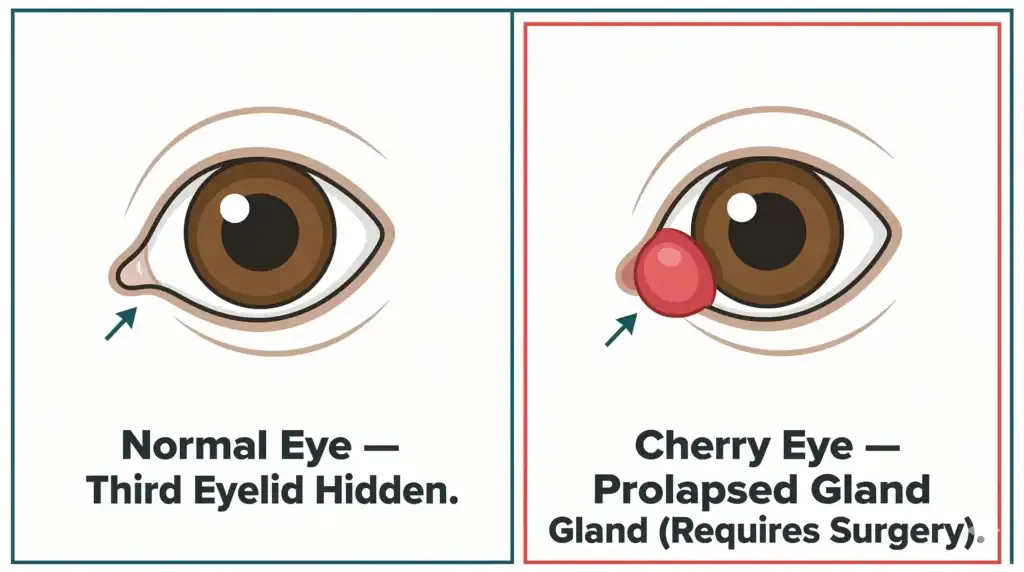
9. Cherry Eye (Prolapsed Third Eyelid Gland)
The gland of the third eyelid (nictitating membrane) pops out of position and appears as a red, oval mass in the inner corner of the eye. It looks alarming but is not immediately painful — though it becomes so without treatment.
Breeds most affected: Bulldogs, Cocker Spaniels, Beagles, Bloodhounds, Neapolitan Mastiffs.
Signs to watch: visible pink or red fleshy mass in the inner corner of the eye, increased discharge, eye rubbing.
Action: surgical replacement of the gland. The gland must be repositioned, not removed — it produces a significant portion of the eye’s tear film. Removal leads to lifelong dry eye.
10. Foreign Body (Grass Seed, Dust, Debris)
Grass seeds are a particular hazard — they can migrate under the eyelid, causing intense localised irritation, tearing, and squinting from one eye only.
Signs to watch: sudden onset squinting or tearing from one eye only, visible pawing at one eye, discharge from one eye while the other is clear.
Action: examine the eye carefully under good light. Flush with sterile saline if debris is visible. If you cannot see or remove the object easily, vet same day — grass seeds can penetrate the eye tissue.
URGENT / EMERGENCY
11. Corneal Ulcer
An erosion or wound on the surface of the cornea. Can be caused by a scratch, a foreign body, KCS, or entropion. Corneal ulcers are painful and can progress to perforation if untreated.
Signs to watch: sudden squinting or holding one eye closed, cloudy or bluish haze on the cornea, clear or slightly cloudy discharge, the dog rubbing the eye urgently.
Action: vet same day. Diagnosis is with fluorescein stain (painless). Treatment includes antibiotic drops, pain relief, and an e-collar to prevent rubbing. Deep ulcers may need surgery.
12. Glaucoma
Increased pressure inside the eye caused by failure of the fluid drainage system. Glaucoma is acutely painful and can cause permanent blindness within hours to days if not treated as an emergency.
Breeds most at risk: Cocker Spaniels, Basset Hounds, Chow Chows, Siberian Huskies, Beagles, Shih Tzus.
Signs to watch: sudden onset of a visibly larger or bulging eye, redness of the white of the eye, cloudy cornea, head shyness, the dog bumping into things, extreme light sensitivity.
Action: emergency vet immediately. This is a sight-threatening emergency. Treatment includes pressure-reducing eye drops and, in some cases, surgery or eye removal to relieve chronic pain.
When to Go to the Emergency Vet
Go immediately if your dog has:
- Any bloody discharge from the eye
- A visibly swollen, bulging, or cloudy eye
- Sudden squinting or holding one eye completely closed
- A visible wound or foreign object in or near the eye
- Sudden vision loss (bumping into things, startled response)
- Discharge following a facial trauma or fight with another animal
Home Care for Minor Eye Discharge
For clear or mild discharge with no redness or squinting:
- Dampen a clean cotton pad with sterile saline or cooled boiled water
- Wipe gently from the inner corner outward — use a fresh pad for each eye
- Never use the same cloth on both eyes (prevents cross-contamination)
- Never use human eye drops unless specifically directed by a vet
- Keep the fur around the eye trimmed to prevent irritation
- Check the eye daily and note any changes in colour or volume of discharge
Frequently Asked Questions
Can I use human eye drops on my dog?
Plain sterile saline (no additives) is safe to flush a dog’s eye. Human medicated eye drops — including those with antihistamines, redness-reducers, or antibiotics — should not be used without veterinary guidance. Some human formulations contain preservatives or active ingredients that are irritating or harmful to dogs.
What does green eye discharge in dogs mean?
Green discharge almost always indicates a bacterial infection. It is one of the clearest signals that the eye needs veterinary attention and prescription antibiotic drops. Do not wait to see if it resolves on its own — bacterial conjunctivitis worsens quickly and can spread to the other eye.
Why does my dog have brown staining under its eyes?
The brown or rust-coloured staining is caused by porphyrins — iron-containing compounds in tears that oxidise and stain light-coloured fur when tears overflow onto the face. It is a cosmetic consequence of epiphora (excess tearing). The staining itself is harmless, but the underlying cause of the overflow should be investigated and treated.
Can dry eye in dogs be cured?
KCS (dry eye) is almost never cured — it is managed long-term with daily eye drops (cyclosporine or tacrolimus) that stimulate remaining tear gland function. With consistent treatment, most dogs achieve a good quality of life with minimal discomfort. Stopping treatment causes the condition to return.
Is cherry eye painful for dogs?
Initially, cherry eye is more uncomfortable than acutely painful — the prolapsed gland causes irritation and increased discharge. Over time, without treatment, the exposed gland becomes inflamed and swollen, causing increasing discomfort. The longer it is left untreated, the more complicated the surgical repair becomes.
Sources
- American College of Veterinary Ophthalmologists: acvo.org
- American Kennel Club — Eye Conditions in Dogs: akc.org
- Merck Veterinary Manual — Conjunctivitis in Dogs
- Cornell University College of Veterinary Medicine — Glaucoma in Dogs: vet.cornell.edu